
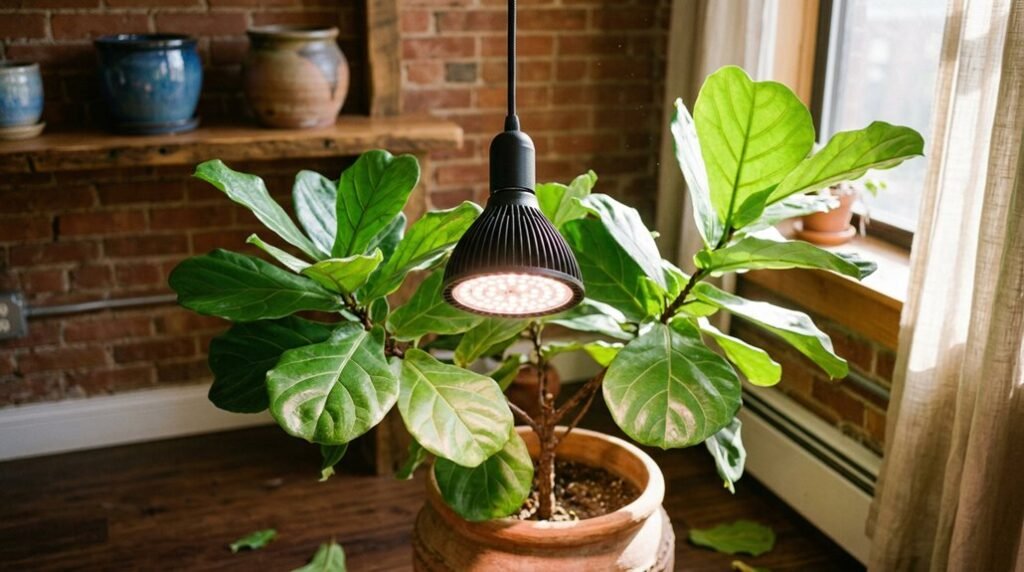


You need grow lights that actually work for your pothos, succulents, and tomatoes, not just bright decorations. In 2026, full-spectrum LEDs at 4000K daylight with CRI above 90 deliver the PAR your plants crave for photosynthesis, measured in PPFD at 12 inches.
SANSI’s 36W covers larger setups, while their 10W and dimmable 5W suit compact herb gardens on countertops, all fitting standard E26 sockets with 25,000-hour lifespans certified ETL-safe. Briignite’s A19 bulbs blend into fixtures without screaming “greenhouse,” though placement matters more than wattage alone.
Your Fiddle Leaf Fig in USDA Zone 10 or your basil seedlings both demand specific photoperiods, typically 14-16 hours under timers. Matching spectrum to growth stage, from vegetative blue peaks to flowering red boosts, determines whether you harvest crisp ‘Genovese’ basil or watch leggy seedlings stretch toward inadequate windows. The five bulbs ahead solve distinct problems, but one critical specification separates thriving jungles from disappointed plant parents.
Briignite Grow Light Bulbs, LED Grow Light Bulb A19 Bulb, Full Spectrum

FULL SPECTRUM & NATURAL LIGHT: A19 full spectrum grow light appears 4000K white to eyes but has a red/blue light spectrum. Same as natural sun shine, perfect for tomatoes,...
If you’re cultivating tomatoes, cucumbers, peppers, leafy greens, or herbs under artificial light, you’ll find the Briignite LED Grow Light Bulb A19 delivers precisely the spectrum and intensity your plants demand without transforming your living space into an alien laboratory.
You’ll appreciate the 4000K warm white output, which blends seamlessly with standard home lighting while still providing the red and blue wavelengths essential for photosynthesis across all growth stages. The bulb generates 1000 lumens across a 180-degree spread, yet draws merely 11 watts, matching the output of traditional 100-watt incandescents without the heat stress that damages tender seedlings in USDA zones 3 through 10.
Your installation requires no specialized fixtures; the E26 base screws into any standard socket. Position bulbs 12 to 18 inches above seedlings, adjusting height as plants mature to maintain optimal PPF of 25 micromoles per second.
The plastic and aluminum cooling system ensures 25,000 hours of operation, keeping leaf surfaces cool during 14 to 16-hour daily cycles for fruiting varieties or 10 to 12 hours for leafy greens.
Best For: Indoor gardeners growing tomatoes, cucumbers, peppers, leafy greens, or herbs who want effective full-spectrum plant lighting that blends naturally with home decor without requiring specialized fixtures.
Pros:
- Natural 4000K warm white appearance avoids the purple/reddish hue typical of grow lights, integrating seamlessly with standard home lighting
- Highly energy-efficient 11W consumption delivers 1000 lumens equivalent to 100W incandescent with minimal heat generation
- Simple E26 base installation fits any standard socket, eliminating need for additional fixtures or complex setup
Cons:
- 25 micromoles per second PPF may be insufficient for high-light-demanding plants or dense canopies
- 180-degree light spread requires strategic positioning and multiple bulbs for larger growing areas
- 2-count single pack offers limited coverage for gardeners with multiple plants or expanded indoor gardens
Recommended Products

4000K DAYLIGHT: Imitate the solar spectrum, customize a more ideal full life cycle full spectrum supplementary light program, covering the entire visible spectrum of 400nm-780nm; Color rendering index Ra is close to 100, infinitely close to natural light, suitable for every cycle of plant growth, effectively promotes plant growth, and improves crop yield and quality
FULL SPECTRUM & NATURAL LIGHT: A19 full spectrum grow light appears 4000K white to eyes but has a red/blue light spectrum. Same as natural sun shine, perfect for tomatoes, cucumbers, peppers, leafy greens and herbs at all growth stages.

[Full Spectrum + 660NM Supplementary Light] Customized red and white full spectrum, realizes a more ideal full life cycle full spectrum supplementary light program, covering the entire visible spectrum of 380nm-780nm. And extra 660nm red supplementary light helps to flower and fruit and prolong flowering, increases production.
SANSI Grow Lights for Indoor Plants, 36W Plant Lights for Indoor Growing

4000K DAYLIGHT: Imitate the solar spectrum, customize a more ideal full life cycle full spectrum supplementary light program, covering the entire visible spectrum of...
Who benefits most from a 36W full-spectrum solution? You do, if you’re cultivating compact orchids, African violets, or dwarf tomatoes in USDA zones 9-11 that you’ve brought indoors for winter maintenance.
The SANSI C21GL-CE26-36W delivers 4000K daylight spectrum spanning 400nm-780nm with Ra near 100, which mimics natural solar conditions and supports your plants through germination, vegetative growth, and flowering phases without spectrum switching.
You’ll appreciate the 65.6 μmol/s PPF and 265.58 μmol/s/m² PPFD at one foot, measurements that ensure adequate photon delivery for compact growing spaces. The secondary optical lens design directs light precisely where your foliage needs it, reducing waste and improving efficiency over standard bulb configurations.
The Chip on Ceramic technology matters for your setup’s longevity. Ceramic heat sinks, with LED chips soldered directly to the substrate, achieve lower thermal resistance than aluminum alternatives, which means you’ll experience faster heat conduction and higher reliability during extended photoperiods.
The V0 flame-retardant rating and WF2 anti-corrosion shell provide additional security in humid growing environments. Position this lamp 12-18 inches above your canopy, run it 14-16 hours daily for light-loving species, and monitor leaf coloration weekly.
With ETL certification and five-year protection, you’re investing in verified safety and sustained performance.
Best For: Indoor gardeners growing compact flowering plants, orchids, African violets, or dwarf tomatoes in USDA zones 9-11 who need a full-spectrum, low-heat solution for winter maintenance without spectrum switching.
Pros:
- 4000K full-spectrum daylight (400nm-780nm, Ra near 100) supports complete plant life cycle from germination to flowering with natural light mimicry
- Chip on Ceramic technology with ceramic heat sink delivers lower thermal resistance, faster heat conduction, and higher reliability than aluminum alternatives
- Secondary optical lens design improves light utilization with 65.6 μmol/s PPF and 265.58 μmol/s/m² PPFD at 1 ft, directing photons precisely to foliage
Cons:
- 36W output and focused PPFD measurements at 1 ft suggest limited coverage area, requiring multiple units for larger plant collections
- Fixed 4000K spectrum lacks tunability for growers wanting to optimize specific wavelengths for particular growth stages
- No mention of dimming capability or built-in timer, requiring external controls for photoperiod management and intensity adjustment
Recommended Products

4000K DAYLIGHT: Imitate the solar spectrum, customize a more ideal full life cycle full spectrum supplementary light program, covering the entire visible spectrum of 400nm-780nm; Color rendering index Ra is close to 100, infinitely close to natural light, suitable for every cycle of plant growth, effectively promotes plant growth, and improves crop yield and quality

4000K DAYLIGHT: Imitate the solar spectrum, customize a more ideal full life cycle full spectrum supplementary light program, covering the entire visible spectrum of 400nm-780nm; Color rendering index Ra is close to 100, infinitely close to natural light, suitable for every cycle of plant growth, effectively promotes plant growth, and improves crop yield and quality

4000K DAYLIGHT: Imitate the solar spectrum, customize a more ideal full life cycle full spectrum supplementary light program, covering the entire visible spectrum of 400nm-780nm; Color rendering index Ra is close to 100, infinitely close to natural light, suitable for every cycle of plant growth, effectively promotes plant growth, and improves crop yield and quality
SANSI 5W Dimmable Grow Light Bulb, Full Spectrum with Remote Control

DIMMING & TIMING: Remote Control Available - No need to unplug/re-plug! It is designed with a 4, 8, 12 timing function and offers 4 Dimming brightness levels from 25% to 50%...
Why wrestle with timers and dimmers when you’re tending African violets on a kitchen sill or coaxing a monstera through a dim winter? You grab the SANSI 5W Dimmable Grow Light Bulb, point its remote, and you’re done. No crawling behind furniture, no unplugging rituals.
You control four timing cycles, 4 through 12 hours, and four brightness tiers from 25% to full intensity, all from your chair. The PAR20 ceramic housing directs 53.85 μmol/s/㎡ of full-spectrum photons, 400nm to 780nm, exactly where your philodendron or Bawang fern needs them.
You install this ETL-listed bulb anywhere standard sockets exist, knowing its patented ceramic heat sink and 25,000-hour lifespan outlast cheaper A19 alternatives. Your orchids, succulents, and devil’s ivy receive natural-quality light without the natural guesswork.
Best For: Indoor plant enthusiasts seeking convenient remote-controlled lighting for small to medium houseplants like African violets, monsteras, and succulents in standard socket fixtures.
Pros:
- Remote control enables effortless dimming (25%-100%) and timing (4/8/12 hours) without unplugging or repositioning
- Ceramic PAR20 design with secondary lens delivers targeted 53.85 μmol/s/㎡ full-spectrum light (400nm-780nm) for improved PPFD utilization versus standard A19 grow bulbs
- 5W actual draw with 25,000-hour lifespan backed by patented ceramic heat sink technology
Cons:
- 500 lumen output and focused PAR20 beam may prove insufficient for larger plant collections or high-light-demanding species requiring broader coverage
- Remote control dependency means lost or malfunctioning remotes disable dimming and timing functions
- Single fixed spectrum (400nm-780nm) lacks tunability for optimizing specific growth stages (vegetative vs. flowering) compared to multi-channel LED systems
Recommended Products
4000K DAYLIGHT: Imitate the solar spectrum, customize a more ideal full life cycle full spectrum supplementary light program, covering the entire visible spectrum of 400nm-780nm; Color rendering index Ra is close to 100, infinitely close to natural light, suitable for every cycle of plant growth, effectively promotes plant growth, and improves crop yield and quality

Integrated Stepless Dimming & 3 Timer Settings: The Barrina grow light bulb features an integrated dimming and timer panel directly on the bulb. Effortlessly adjust brightness levels with stepless dimming and set timers for 4/8/12 hours as needed. No additional accessories are required for operation

FULL SPECTRUM & NATURAL LIGHT: A19 full spectrum grow light appears 5000K white to eyes but has a red/blue light spectrum. Same as natural sun shine, perfect for tomatoes, cucumbers, peppers, leafy greens and herbs at all growth stages.
SANSI LED Grow Light Bulbs 2-Pack, 10W Full Spectrum, E26 Base, 4000K
4000K DAYLIGHT: Imitate the solar spectrum, customize a more ideal full life cycle full spectrum supplementary light program, covering the entire visible spectrum of...
Which houseplant enthusiast needs reliable, efficient supplemental lighting without complex installation? You’ll find your answer in SANSI’s 10W LED Grow Light Bulbs 2-Pack, featuring standard E26 bases that screw into any fixture you already own.
These bulbs deliver full spectrum 4000K daylight, spanning 400nm to 780nm to mimic natural solar conditions across all growth cycles. Your plants receive PPF of 16.8 μmol/s and PPFD of 97.91 μmol/s/m² at one foot, with lens-based distribution maximizing light utilization through secondary optical design.
The ceramic construction, utilizing patented Chip on Ceramic technology, replaces traditional aluminum substrates for superior thermal management, extending operational life to 25,000 hours while maintaining flame retardant V0 safety ratings and WF2 anti-corrosion protection.
You’re protected by ETL and CE certifications, plus five-year after-sale support with 24/7 professional assistance available. For houseplants in USDA zones 4 through 11, position these bulbs 12 inches above foliage, running 12 to 16 hours daily during active growth periods.
Best For: Houseplant enthusiasts seeking reliable, efficient supplemental lighting with simple screw-in installation using standard E26 fixtures.
Pros:
- Full spectrum 4000K daylight (400nm-780nm) with high color rendering (Ra near 100) supports all plant growth cycles and promotes improved growth, yield, and quality
- Patented Chip on Ceramic technology and secondary optical design deliver PPF 16.8 μmol/s and PPFD 97.91 μmol/s/m² at 1 foot, with 25,000-hour lifespan and superior thermal management
- ETL listed and CE certified with flame retardant V0 ceramic shell, WF2 anti-corrosion protection, and 5-year after-sale support including 24/7 professional assistance
Cons:
- 10W power output and PPFD of 97.91 μmol/s/m² at 1 foot may be insufficient for high-light demanding plants or larger growing areas
- Single 12-inch mounting distance and 12-16 hour daily runtime recommendation lacks flexibility for varying plant species and growth stages
- Pack of 2 bulbs may not provide adequate coverage for multiple plants or expanded indoor garden setups without additional purchases
Recommended Products

4000K DIMMING & TIMING: Remote Control Available - No need to unplug/re-plug! It is designed with a 4, 8, 12 timing function and offers 4 Dimming 4000K brightness levels from 25% to 50% to 75% to 100%. You don't need to move your plants or the light bulb, just use the remote control to chose the most suitable brightness for your plants growth

Integrated Stepless Dimming & 3 Timer Settings: The Barrina grow light bulb features an integrated dimming and timer panel directly on the bulb. Effortlessly adjust brightness levels with stepless dimming and set timers for 4/8/12 hours as needed. No additional accessories are required for operation

Complete All-In-One Kit - No need to buy separate supplies. This herb starter set comes with 4 plastic planter pots, 4 soil discs, 4 plant markers 4 heirloom herb seed packets, and essential planting tools—everything you need to start your indoor herb garden immediately.
SANSI Grow Light Bulbs for Indoor Plants, 10W Full Spectrum 4000K Daylight

4000K DAYLIGHT: Imitate the solar spectrum, customize a more ideal full life cycle full spectrum supplementary light program, covering the entire visible spectrum of...
What distinguishes a grow light that truly serves your indoor garden?
You’ll find your answer in SANSI’s patented COC technology, where ceramic replaces traditional MCPCB heat sinks, delivering superior thermal management through direct LED-to-ceramic soldering.
This single-pack model C21-GE26-10W produces 4000K daylight across 400nm-780nm, achieving Ra near 100 color rendering that mimics natural solar conditions for orchids, African violets, or ficus benjamina in USDA zones 3-11.
Position this bulb 12 inches above foliage to capture 97.91 µmol/s/m² PPFD, supporting seedling establishment through flowering. The V0 flame-retardant ceramic shell resists corrosion while reinforced insulation eliminates shock hazard.
You’ll appreciate 25,000 hours of operation, backed by ETL certification and five-year protection. Eschew distance recommendations below 6 inches, where reduced IR emission nonetheless demands prudent placement to prevent photoinhibition in tender seedlings.
Best For: Indoor gardeners seeking a reliable, long-lasting full-spectrum grow light for small-to-medium houseplants across all growth stages, particularly those prioritizing safety certifications and thermal efficiency over high-intensity output.
Pros:
- Patented COC technology with ceramic heat sink provides superior thermal management and 25,000-hour lifespan
- ETL-listed with reinforced insulation, V0 flame-retardant shell, and 5-year protection plan for exceptional safety and reliability
- Full spectrum 4000K daylight (400nm-780nm) with Ra near 100 color rendering supports all plant growth stages
Cons:
- Low 10W power output and modest PPFD of 97.91 µmol/s/m² at 1 ft limits effectiveness for light-hungry plants or larger growing areas
- Single-pack offering lacks scalability for multiple-plant setups without purchasing additional units
- Requires careful placement at 6+ inches to avoid photoinhibition, reducing flexibility for compact growing spaces
Recommended Products

Original Sunshie Mode - Brightness auto change, simulating sunshine's brightness changing in a day, from sunrise to sunset. Your plants will love the lamp just like real...
Factors to Consider When Choosing Grow Light Bulbs for Houseplants
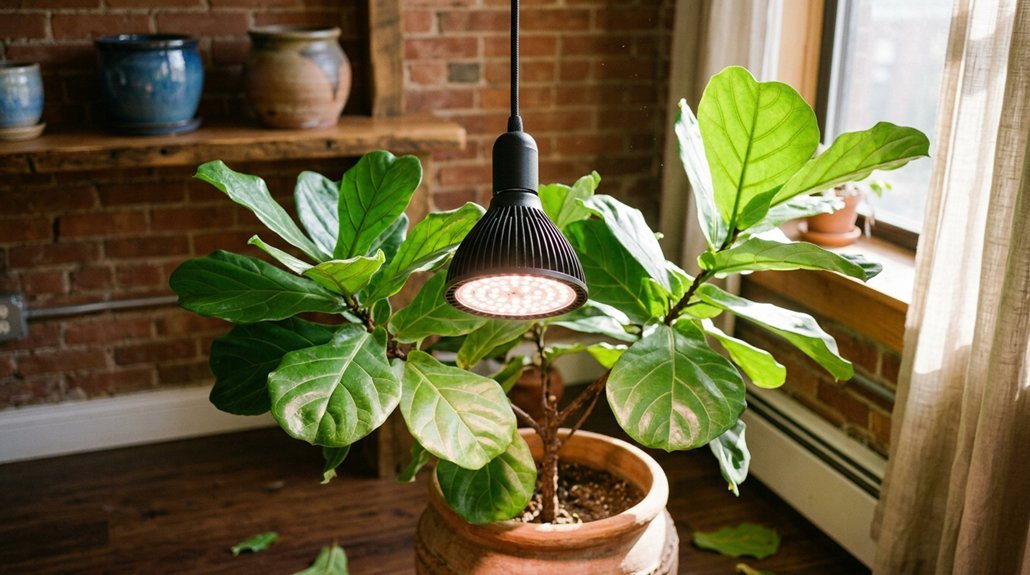
When you’re selecting grow light bulbs for your houseplants in 2026, you’ll need to weigh light spectrum quality, energy efficiency rating, heat output levels, bulb lifespan duration, and installation compatibility against your specific growing conditions, whether you’re nurturing tropical monstera deliciosa in USDA zone 10 or overwintering tender pelargoniums in zone 6.
You’ll want to prioritize full-spectrum LEDs emitting 4000-6500K for vegetative growth, while verifying that your fixtures handle the bulb’s wattage and physical dimensions, since a mismatched installation can reduce your effective coverage by 30% or more. By systematically evaluating these five factors before purchase, you’ll position your ficus lyrata, pothos cultivars, and flowering african violets to receive consistent, efficient illumination through every growth stage.
Recommended Products

FULL SPECTRUM & NATURAL LIGHT: A19 full spectrum grow light appears 5000K white to eyes but has a red/blue light spectrum. Same as natural sun shine, perfect for tomatoes, cucumbers, peppers, leafy greens and herbs at all growth stages.
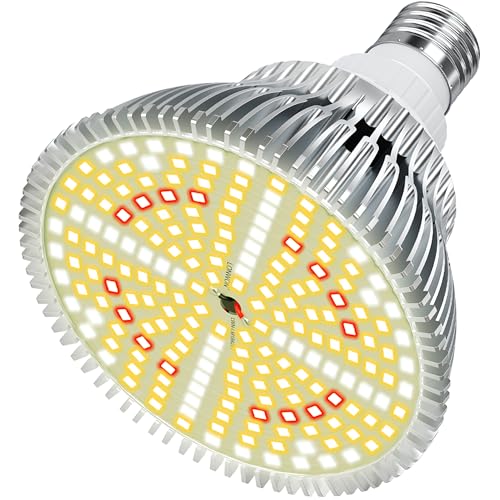
NATURAL 4000K WARM GLOW: Say goodbye to harsh purple glare. Bring sunlight-like warmth into your home with a beautiful 4000K natural glow. These LED grow light bulbs for indoor plants help your greenery thrive while blending perfectly into your garden room. Turn any corner into a peaceful retreat you’ll look forward to walking into every day

FULL SPECTRUM & NATURAL LIGHT: A19 full spectrum grow light appears 5000K white to eyes but has a red/blue light spectrum. Same as natural sun shine, perfect for tomatoes, cucumbers, peppers, leafy greens and herbs at all growth stages.
Light Spectrum Quality
Why does the spectrum of your grow light matter so much? You need full-spectrum bulbs, approximately 4000K with red and blue wavelengths, because they mimic natural sunlight and support all growth stages of your houseplants, from vegetative growth to flowering.
You should also prioritize a high Color Rendering Index, with Ra near 100, since this helps you accurately assess your plant’s health and color development under the light. When evaluating intensity, you’ll encounter PPFD, measured in μmol/m²/s at a given distance, which quantifies how much usable photosynthetically active radiation actually reaches your plants.
Some bulbs specify PPF in μmol/s as total photosynthetic output, and together with distance, this informs how much light your canopy receives. Finally, choose bulbs with low infrared emission and good heat management, so you reduce heat stress and light burn when positioning fixtures close to foliage.
Energy Efficiency Rating
Thermal management demands equal attention, because excessive heat degrades both efficiency and bulb longevity. You should favor bulbs with ceramic or advanced heat-sink technology, specifically COC designs, to lower thermal resistance and sustain light output over time.
Compare brightness relative to wattage carefully: a bulb delivering 1000 lumens at 11 watts offers substantially higher efficiency than a traditional 100W bulb, directly reducing your energy consumption. Look for a high PPF rating, 25 μmol/s or higher, to gauge total photosynthetically usable light output. Check PPFD values at typical distances, approximately 1 foot, where ranges like 97.91–265.58 μmol/s/m² indicate adequate delivery for indoor setups.
Finally, verify ETL or CE certifications, because safety compliance correlates with consistent energy performance across the bulb’s entire lifespan.
Heat Output Levels
How much heat your grow light bulb generates can make or break your houseplant collection, particularly if you’re nurturing delicate specimens like African violets (Saintpaulia ionantha), calatheas, or ferns that sit within 12 inches of the fixture.
You need to prioritize lower heat output to prevent stress or burn on sensitive houseplants, especially when your plants grow in close proximity to the bulb. Many 2026 grow bulbs now advertise reduced IR emission and cool-running designs, such as ceramic heat sinks, to minimize heat transfer to your plants.
Remember that wattage alone isn’t enough to gauge heat risk, since higher efficiency bulbs can emit similar heat at lower wattages due to better thermal management. Bulbs with integrated cooling systems, whether aluminum or ceramic heat sinks, typically maintain lower surface temperatures during operation.
For your heat-sensitive species or tight growing spaces, you should prioritize bulbs with low infrared radiation and explicit heat-output specifications, such as reduced IR or measured PPFD at close distances.
Bulb Lifespan Duration
When you’re investing in grow light bulbs for your houseplants, you’ll want to contemplate exactly how long those bulbs will keep your Monstera deliciosa or Ficus lyrata thriving before replacement becomes necessary. Most quality grow light bulbs list a lifespan around 25,000 hours, meaning years of continuous operation before you need replacements. You’ll find that longer rated lifespans reduce your maintenance frequency and lower total costs over time.
Heat management significantly influences actual bulb longevity. Ceramic heat sink designs, often labeled COC, actively dissipate thermal buildup to extend operational life. While ETL or CE certifications don’t directly guarantee lifespan, they reflect safety and quality standards that accompany durable construction.
Your real-world results will vary based on operating conditions, including distance from plants, daily usage hours, and ambient temperature. Position bulbs appropriately, monitor heat levels, and you’ll maximize your investment while keeping tropical specimens healthy across USDA zones 10 through 12.
Installation Compatibility
Where exactly will your new grow light bulb fit into your existing setup, and will it actually work with the fixtures you already own? You need to start by checking that your chosen bulb carries a standard E26 base, since this common threading lets you screw it directly into household sockets without buying adapters or rewiring anything. Next, you’ll want to examine the bulb’s size and form factor, whether that’s A19, PAR20, or PAR38, because oversized bulbs won’t fit under narrow shades or inside enclosed fixtures, and cramped housings trap heat.
If your fixture includes dimming switches or remote controls, verify that the bulb supports those features, or you’ll face flickering or early failure. Finally, insist on ETL or CE certifications paired with a 25,000-hour lifespan, so your Monstera deliciosa or Ficus lyrata receives reliable, plant-safe illumination through every growth stage.
Brightness and Coverage
Why settle for a dim corner when your Ficus elastica or trailing Pothos could thrive under brilliant, evenly distributed light? You’ll want to prioritize high lumen output paired with a wide-angle design, ideally 180 degrees, which spreads illumination across a broader footprint so your Monstera deliciosa (USDA zones 10-12) receives uniform exposure without hot spots or shadowed peripheries.
When comparing brightness, examine watts-to-lumens equivalence, recognizing that an 11W LED grow bulb may deliver roughly 100W of traditional incandescent brightness. You should verify PPFD values measured at one foot, since this quantifies photosynthetic photon flux density, the actual usable light reaching your plant’s canopy per unit area.
Seek fixtures incorporating secondary optics or lenses, which refine distribution and improve utilization for targeted coverage. Ensure your selection provides full-spectrum output near 4000K with balanced red and blue components, supporting consistent development across all growth phases and promoting even canopy architecture in compact urban growing environments.
Plant Growth Stages
This versatility matters because your houseplants won’t announce their stage changes on a schedule you control, and a bulb rated for all growth phases eliminates the guesswork of timing spectrum swaps when your trailing Philodendron brasil suddenly shifts energy toward bloom production. You’ll want full-spectrum bulbs near 4000K with red and blue elements, as these support seedlings through flowering with balanced light for roots, foliage, and fruiting.
Higher PPFD accelerates vegetative growth while ample blue light builds sturdy stems. Broad CRI near 100 lets you accurately assess plant health and color, catching problems early. Look for lamps specifying suitability for tomatoes, cucumbers, peppers, leafy greens, and herbs, which signals true versatility.
Longer 25,000-hour lifespans and lower heat output reduce maintenance and heat stress across frequent cycle changes.
Safety Certifications
How do you know the grow light you’ve selected won’t overheat near your moisture-loving Calathea or short-circuit during that 16-hour photoperiod your tomatoes demand? You’ll verify safety by checking for ETL listing or CE certification on your bulb packaging, as these marks confirm independent testing against recognized electrical standards for indoor lighting applications.
These certifications signal that your fixture has undergone rigorous evaluation for fire prevention, shock resistance, and operational stability in high-humidity environments like your greenhouse or kitchen herb setup spanning USDA zones 6-10.
You’re investing in 25,000 hours of consistent performance, backed by manufacturer warranties that honor certified quality. When you prioritize certified bulbs, you build reliable foundation lighting for seed-starting tomatoes in February or maintaining your Ficus lyrata through dim winter months, ensuring both your plants and your home remain secure throughout every growth stage.