
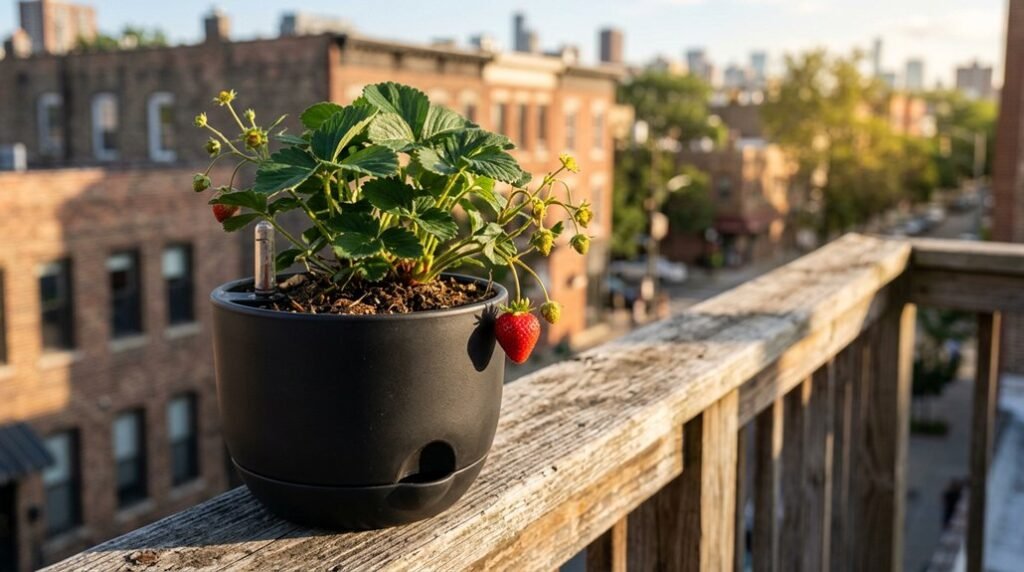


Can you really harvest sweet, sun-ripened strawberries from a cramped balcony in USDA zones 4 through 8? You absolutely can, provided you position your containers along a south- or west-facing rail where they’ll soak up six to eight hours of direct light daily, supplementing with full-spectrum grow lights when winter days drop below ten hours. You’ll select compact everbearing cultivars like ‘Albion,’ ‘Seascape,’ or ‘Tristar,’ proven performers in confined spaces, then plant them in vertical stackers or 20- to 30-centimeter pots filled with a well-draining, slightly acidic mix—pH 6.0 to 6.5—spaced precisely 30 centimeters apart to encourage air circulation and fungal disease prevention. Your success hinges on meticulous watering at the soil base, never the foliage, combined with biweekly applications of balanced 10-10-10 fertilizer during fruiting season, plus pine needle mulch to regulate moisture and discourage slugs. Pinch those energy-stealing runners weekly, drape bird netting before berries blush red, and relocate pots indoors when temperatures flirt with freezing. The reward awaits.
Confirm Your Balcony Gets 6+ Hours of Direct Sun
Where should you begin when growing strawberries on a balcony? You should begin by confirming your space receives at least 6–8 hours of direct sunlight daily, since strawberries demand this exposure for optimal flowering, fruit production, and balcony growth that yields sweet, abundant harvests.
You will want to position your containers, hanging baskets, or vertical planters where they capture balanced sun, preferably on south- or west-facing railings or floors, so every ray contributes to vigorous development. If your outdoor conditions fall short, you should supplement with grow lights to maintain the energy levels your plants require. In extremely hot climates, you may need to provide partial shade during peak afternoon heat to prevent leaf scorch, though you must still meet that total daily light threshold.
Recommended Products

Grow 16 Plants in Just 1 Square Foot Maximize your harvest with this vertical planter tower featuring 4 stackable tiers and 16 planting sites. Perfect for strawberries, herbs, lettuce, and small vegetables in tight spaces.

Grow 16 Plants in Just 1 Square Foot Maximize your harvest with this vertical planter tower featuring 4 stackable tiers and 16 planting sites. Perfect for strawberries, herbs, lettuce, and small vegetables in tight spaces.
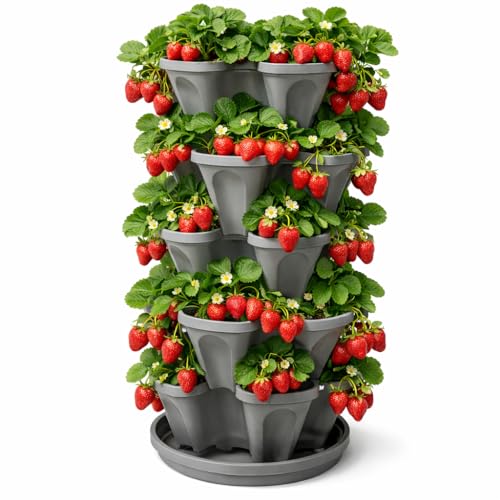
SPACE-SAVING VERTICAL GARDEN PLANTER – Grow more in less space with this 5-tier stackable planter designed for patios, balconies, decks, apartments, and small gardens. Perfect for growing strawberries, herbs, lettuce, vegetables, flowers, and succulents in a compact vertical tower.
Pick an Everbearing Variety for Continuous Summer Harvests
You’ll want to select everbearing varieties like Albion or Ostara, which produce fruit continuously from late spring through fall rather than delivering a single spring flush, making them ideal for the limited space of balcony containers where every harvest window matters. These day-neutral cultivars, hardy in USDA zones 4–8, will reward your 6–8 hours of daily sunlight with repeated yields if you fertilize every 2–4 weeks with balanced 10-10-10 fertilizer and promptly pinch off runners to direct energy toward fruit production. By choosing everbearing types and pairing them with consistent moisture in well-draining soil, you’ll secure a steady supply of fresh berries throughout the summer months rather than waiting for one brief seasonal peak.
Recommended Products

SEASCAPE STRAWBERRIES: Most productive, yield large, juicy, firm berries with excellent flavor.

Enjoy a great harvest of super-sweet berries in your home garden with Bonnie Plants Strawberry

Planting and Growing Requirements: Before putting them outside they need to be started in a controlled environment as a plug or in a pot first. Like the red cup picture above.
Why Everbearing Varieties Excel
Why settle for a single spring harvest when your balcony could yield fresh strawberries from late spring straight through to the first frost? You’re choosing everbearing varieties because they transform limited space into continuous productivity, a cornerstone principle in successful container gardening.
- You’ll harvest repeatedly from May until autumn frost, not just one brief window.
- Your containers reward you steadily, as day-neutral genetics trigger fruiting regardless of day length.
- You’ll maximize vertical square footage, crucial when every inch of balcony matters.
- You’ll enjoy predictable yields without replanting, letting you plan meals around your harvest.
Select strawberries like ‘Albion’ or ‘Ostara’ for proven container performance, and you’ll secure months of fresh fruit from compact, manageable plants that thrive under your care.
Top Container-Friendly Options
How do you transform a modest balcony into a source of fresh, sun-warmed strawberries from May through October? You master container gardening by selecting everbearing varieties bred specifically for strawberries in pots.
Choose Albion or San Andreas, both renowned for compact growth and reliable yields in confined spaces. You’ll need 10–12 inch deep containers with excellent drainage to support their root systems. Position your pots where they’ll receive 6–8+ hours of direct sunlight daily, or supplement with grow lights during shorter days. Space plants 30 cm apart and prune runners regularly, directing all energy toward continuous fruiting. With proper care from USDA zones 4–9, these everbearing varieties reward your efforts with steady harvests throughout summer and into autumn, turning your balcony into a productive berry patch.
Maximizing Summer Yields
What distinguishes a balcony that produces sporadic handfuls of berries from one that delivers steady harvests all summer long? You choose everbearing, or day-neutral, varieties that fruit continuously rather than once in spring, and you commit to the precise care that sustains them.
- Select compact everbearing cultivars like Albion, Evie 2, or San Andreas, bred for container success and repeated fruiting cycles.
- Position your pots where they’ll receive 6–8 hours of direct sun, supplementing with grow lights if your balcony faces north or suffers shade from neighboring buildings.
- Prune runners ruthlessly and fertilize every 2–4 weeks with balanced formula, directing energy into berries instead of vegetative spread.
- Harvest ripe strawberries in cool morning hours, plucking only fully colored fruit to signal the plant to keep flowering.
Follow this protocol, and you’ll transform modest balcony yields into months of fresh picking.
Choose Vertical Stackers or Long Planters for Your Space
You’ll maximize your limited balcony footprint by selecting either vertical stackers, such as the 5-tier Tectsia Strawberry Vertical Planters Tower Garden with its central support pole, or long, skinny rectangular planters that replace space-hogging traditional pots. Vertical systems position each tier to capture your balcony’s 6-hour sunlight requirement while improving airflow between plants, and the Dark Grey Tectsia model available on Amazon demonstrates how a single compact structure can host multiple strawberry plants without crowding your floor space. Long planters offer similar efficiency for linear balcony railings, letting you arrange everbearing varieties like Albion or Seascape in orderly rows that simplify watering and harvesting routines.
Recommended Products
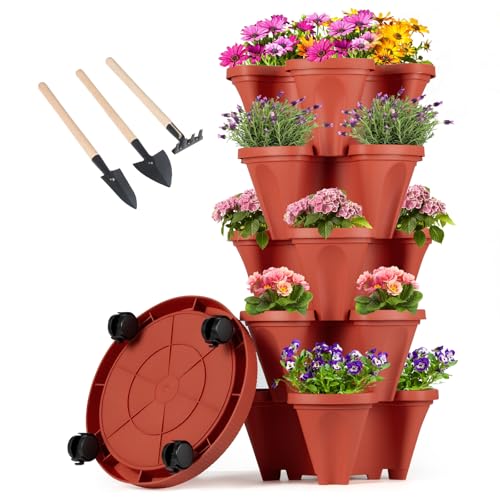
SAVE FLOOR SPACE - Stackable vertical planter tower

Space-Saving Vertical Gardening: Maximize your growing potential with staggered tiered planting! By smartly utilizing vertical space through height-varied layers, this planter lets you grow more plants while saving precious floor space—good for compact balconies, cozy patios, or tight indoor corners.

Vertical Planter Benefits
Where space is tight on your balcony, vertical planters transform an otherwise unusable footprint into a productive growing zone, and you’re wise to contemplate either stackable towers or elongated rectangular containers depending on your specific layout. Vertical planter systems, particularly stackable towers like the Tectsia Strawberry Vertical Planters Tower Garden, maximize your growing potential through container gardening that demands minimal square footage.
You’ll appreciate these core advantages when cultivating balcony strawberries in vertical configurations:
- Space efficiency: A 5-tier tower occupies a single pole position, freeing your floor for seating or additional containers.
- Sun optimization: You can position units to capture that essential 6-hour direct sunlight exposure.
- Proven success: Fellow growers endorse these setups for reliable fruit production, including family-friendly arrangements.
- Root health: Proper 20–30 cm depth accommodates spread while maintaining drainage.
Long Planter Advantages
Why limit yourself to towers when a long, skinny rectangular planter offers equally compelling advantages for your balcony strawberry operation? While vertical planters stack upward, long planters stretch horizontally, giving your balcony strawberries a shallow, uninterrupted root run that mimics their native growing conditions. You’ll find these containers easier to water evenly, since moisture distributes naturally across one level rather than draining unpredictably through multiple tiers.
Long planters also simplify maintenance. You won’t monitor moisture as obsessively as you would with vertical planters, where height creates uneven drying patterns. Your plants receive consistent sun exposure without shadowing from upper tiers. For beginners especially, long planters reduce the guesswork in drainage management and light allocation. Choose this straightforward approach when you want reliable harvests without the structural complexity of stacked systems.
Space Maximization Tips
How can you coax the greatest yield from your cramped balcony without sacrificing plant health? You’ll master balcony gardening by selecting containers that exploit every available inch, whether skyward or along your railing.
Consider these proven strategies:
- Install vertical planters, such as the 5-tier Tectsia Strawberry Vertical Planter, which stacks strawberries around a central pole, converting empty air into productive growing space.
- Deploy long, rectangular planters along balcony edges, creating narrow planting rows that preserve your walking area.
- Space plants 30 cm apart, ensuring stackable units allow air circulation between tiers to prevent fungal issues.
- Position containers for 6–8 hours of direct sun, supplementing with grow lights when necessary, and monitor moisture diligently since vertical setups drain unevenly compared to traditional pots.
Mix the Right Soil for Container Drainage and Nutrition
The foundation of your strawberry crop starts with soil that breathes as readily as it nourishes, and you’ll want to combine a loose, fertile, well-drained potting mix with a pH between 6.0 and 6.5 to keep roots healthy and productive. You’ll achieve proper drainage by blending garden soil, compost, and cocopeat or sand, which prevents compaction and maintains aeration. Avoid heavy garden soil that suffocates roots in containers.
Check your soil pH with a simple meter, adjusting with sulfur if needed. Select containers with adequate drainage holes, then mulch with straw or wood chips to regulate temperature and moisture. Fertilize every 2–4 weeks using balanced, water-soluble or slow-release formulas, but skip high-nitrogen products that sacrifice fruit for foliage.
Recommended Products
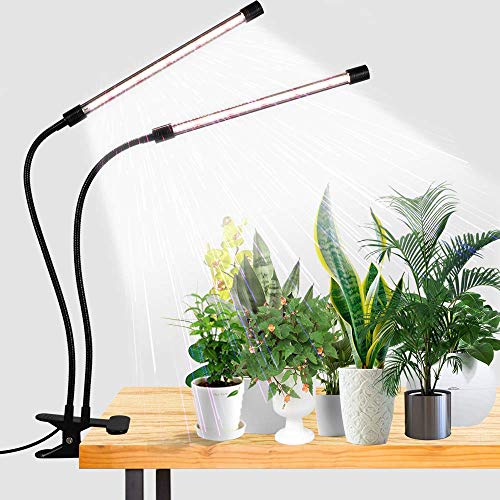
6000K White Light - equipped with 10 Red + 74 White LEDs, this growing Lamp is similar to the full-spectrum sunlight at noon,that is professionally designed for indoor garden plants.Moreover, its color rendering index is as high as 95, the light is soft and flicker-free, which is very suitable for reading lamp

NOTE: The product stand needs to be pressed down by the flower pot to be stable. Not wireless style. 2 Installation Methods: Specially designed plant light for indoor plants, which can be inserted in the soil or stand for lighting.Unique and easy to assemble and disassemble.
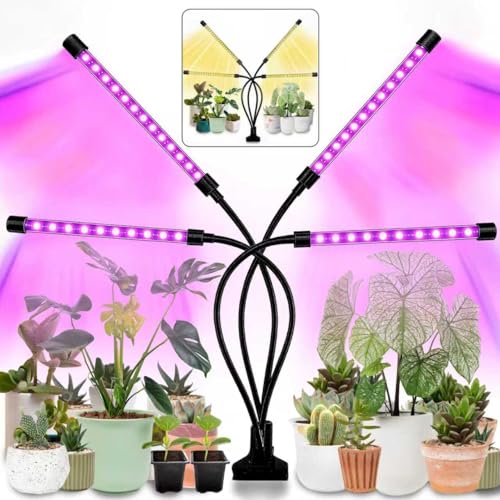
🌻Efficient LED Combination: This LED lamp has grow lights made up of 80 efficient growing LEDs ( 32 red lights, 12 blue lights,20 yellow lights and 16 white lights). It meets the conditions of plant growth without sunlight. 1--Full Spectrum(380nm-800nm): Suitable for all plants to root and sprout. 2--Red(660nm)+BLUE(460nm) Spectrum: for blooming and fruits. 3--Red+Blue+Full Spectrum: A mix of Red+Blue+Warm White is best to fuel the growth of your plants.
Space Plants Properly to Maximize Your Balcony Yield
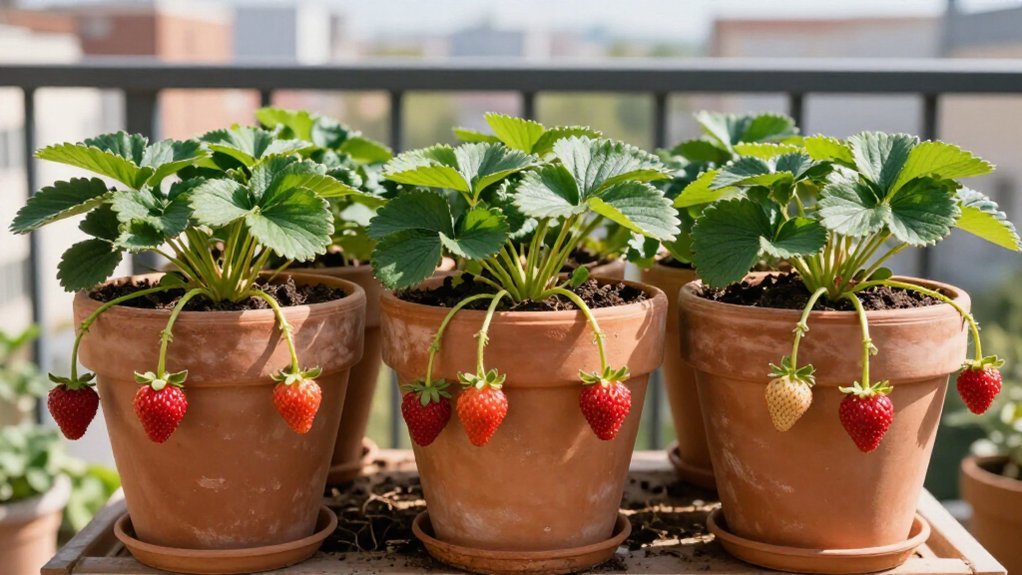
Wherever your balcony’s dimensions fall on the compact-to-spacious spectrum, you’ll unlock far greater harvests by thinking vertically and spacing deliberately rather than cramming every corner with pots.
Master proper planting spacing with these proven strategies:
- Space your strawberries 30 cm apart to promote air circulation and vigorous growth.
- Select containers 20–30 cm deep with drainage holes to accommodate root spread and prevent waterlogging.
- Install vertical systems: stacked planters or hanging baskets multiply your balcony capacity without sacrificing accessibility.
- Limit each small pot to 2 plants, or 3 per square foot for compact cultivars, avoiding the overcrowding that stunts development.
You’ll position your pots where they capture 6–8 hours of direct sunlight daily, supplementing with grow lights when needed. With disciplined spacing, your limited balcony transforms into a highly productive strawberry garden.
Recommended Products

BUILT FOR AROIDS, LOVED BY TROPICAL PLANTS: This chunky aroid potting mix was crafted for the way aroids actually grow - clinging to bark, craving airflow, hating soggy roots; works beautifully for Monstera, Philodendron, Alocasia, Anthurium, Pothos, Peace Lily, and most tropical houseplants

Peat moss naturally acidifies the soil, making it perfect for plants that thrive in acidic environments—no need for extra acidifier products like sulfur.

Optimal pH Balance: Expert blend, ideal acidic environment for azaleas, rhododendrons, and blueberries and more, ensures pH balance for growth and vibrant blooms
Position Pots for Morning Sun and Good Air Flow
Why do some balcony strawberry plants thrive while others struggle with pale leaves and sour fruit? You’ll find the answer in how you position your containers for sunlight and airflow. Place your pots where they’ll receive 6–8 hours of direct sunlight daily, prioritizing gentle morning rays that fuel photosynthesis without scorching delicate foliage. This sunlight exposure develops sugars in developing berries, transforming tart fruit into sweet, market-quality harvests.
Space your containers approximately 30 centimeters apart to create essential airflow between plants. This circulation prevents fungal diseases, strengthens stems, and reduces humidity buildup that invites gray mold. Select containers with drainage holes and a gravel base layer to eliminate standing water.
When balcony space is limited, install vertical or hanging planters to maximize both sun capture and air movement. If natural light falls short, supplement with full-spectrum grow lights to maintain consistent fruiting cycles.
Recommended Products

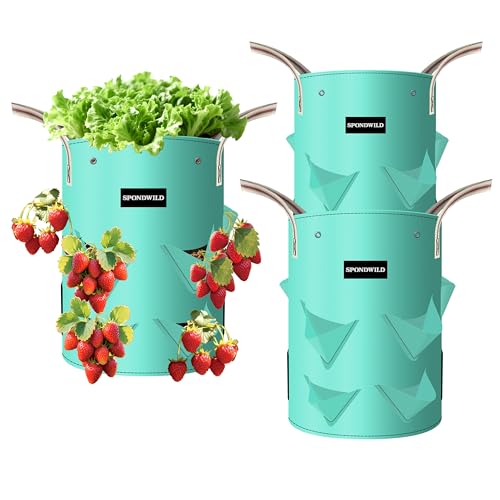
PE Material: Features excellent UV resistance and high tensile strength-withstands long-term sun exposure without degradation and resists tearing even with heavy soil/plant loads. Its moisture-retentive property slows soil evaporation, reducing frequent watering needs, saving your time while ensuring plants stay consistently hydrated

【3 Tier Raised Garden Bed】The vertical garden planter adopts a tiered design, so there is enough space to plant and divide vegetables, herbs, flowers, etc. Save a lot of space for you and keep your garden well organized.
Water at the Base and Fertilize Every Two Weeks
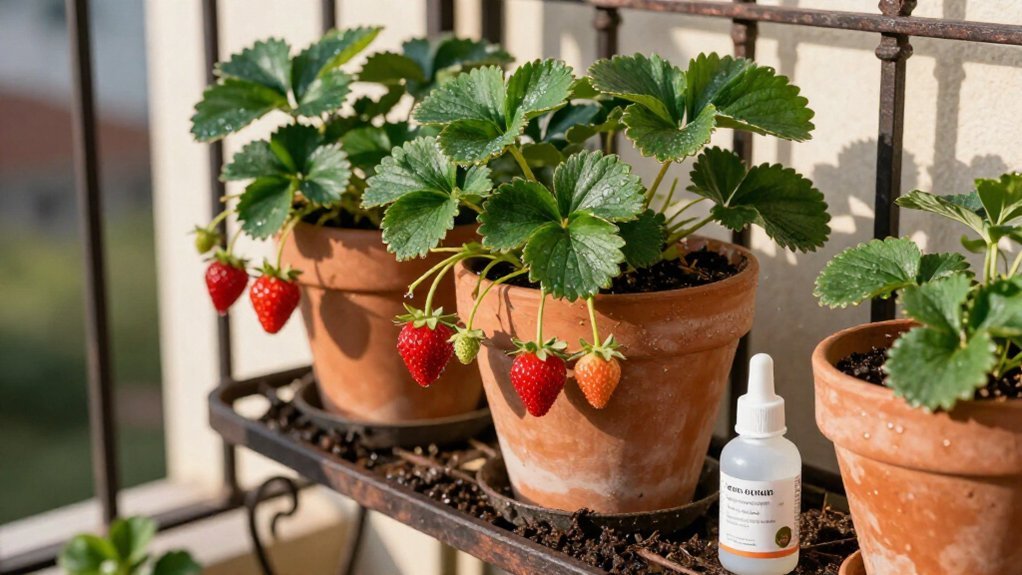
How often should you check your strawberry containers during summer heat, and what signals tell you it’s time to water?
Inspect strawberry pots twice daily when temperatures exceed 85°F—water when soil feels dry to your first knuckle.
You should inspect your pots twice daily when temperatures exceed 85°F, since container soil dries rapidly. When the surface feels dry to your first knuckle, it’s time to water at the base, directing moisture to the root zone without splashing the crown or leaves. You must maintain excellent drainage by selecting pots with multiple holes and adding a gravel layer beneath your potting mix, preventing the root rot that destroys container strawberries.
To optimize your routine:
- Water early morning to reduce evaporation
- Install drip trays beneath pots for indoor setups
- Apply balanced, water-soluble fertilizer every two weeks during fruiting
- Avoid high-nitrogen formulas that promote excess foliage over berries
You’ll fertilize consistently until late summer, then taper as plants enter dormancy.
Recommended Products

Hand Picked Nursery is a veteran and family owned business operating for over 15 years

From Hand Picked Nursery, a veteran and family owned business for over 15 years

Top-Performing Everbearing Strawberry Variety: Seascape strawberries produce large, sweet berries from late spring through fall, offering multiple harvests in a single growing season. Good in Zones 4-7
Mulch and Remove Runners to Direct Energy to Fruit
What material will best shield your balcony strawberry roots from pounding summer sun and thirsty evaporation? You can choose pine straw, wheat straw, sugar cane, or wood chips to mulch around the crown and bare soil of your container strawberries. This layer conserves moisture, regulates temperature, suppresses weeds, and reduces evaporation while keeping fruit cleaner. Apply mulch after planting and refresh it as needed, since it moderates temperatures through hot summers and cool snaps. Your mulch also prevents crown rot by stopping soil splash onto plant tissue when you water.
You’ll need to pair this with smart runner management. Container strawberries send out runners that drain energy from fruit production, so pinch them off as they appear. This directs your plant’s resources toward developing sweet, abundant berries rather than vegetative spread.
Recommended Products

SAVE FLOOR SPACE - Stackable vertical planter tower
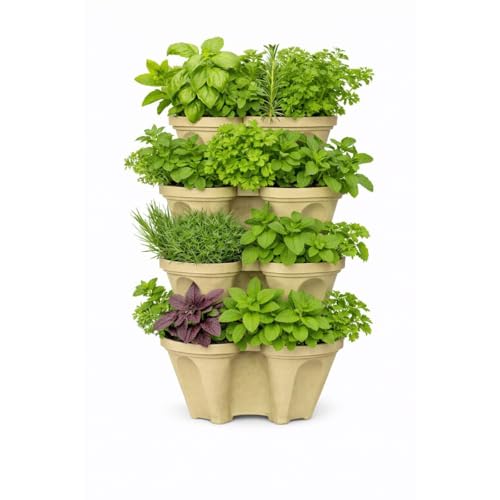
Larger Capacity for Bigger Growth This large vertical planter tower offers increased planting volume and root space, making it ideal for serious gardeners, backyard food production, and high-yield growing.

Space-Saving : This strawberry planter maximizes your gardening space by stacking 5 layers to grow more plants in a compact area. The strawberry tower planter is ideal for patios, balconies, or indoor use
Harvest Ripe Berries and Protect Them From Pests
When exactly should you pluck that first crimson berry from your balcony container? You’ll know your strawberries are ready when they detach easily with a gentle morning twist, as cooler temperatures preserve their delicate sugars.
To maximize your harvest and shield against pests, follow these essential steps:
To maximize your harvest and shield against pests, follow these essential steps:
- Snip berries 1.3 cm above the stem using small shears, preventing damage to the plant.
- Remove runners promptly, directing energy toward fruit production while improving air circulation.
- Install netting over containers to deter birds, and apply organic deterrents for aphids, spider mites, slugs, and snails.
- Monitor closely for Grey Mould and Anthracnose, ensuring adequate spacing between plants to minimize rot.
Your vigilance rewards you with sweet, unblemished fruit throughout the season.
Recommended Products

5000K White Full Spectrum Light: Barrina T5 grow lights 1ft provide indoor plants with full-spectrum sunlight replacement. We provide the most reasonable grow light wave based on the ratio of the absorption of the plant

Unique Exterior Design: This led grow light strip 1ft made in a black casing with aluminum instead of white casing. Make it look even better and more integrated into your fine home furnishings. Dark cords instead of white so as to minimize the observance of cords running through your plant displays

Designed for Large & Tall Indoor Plants:Designed specifically for large indoor plants and tall plants that need stronger and wider light coverage. Helps big plants thrive even in low-light areas like living rooms, corners, or offices.Provides full spectrum light (380nm–800nm) to support every stage of plant growth. A perfect sunlight replacement for indoor plants.
Move Pots Indoors for Winter or Start Fresh Next Spring
Where will your strawberries spend the winter months when balcony temperatures plummet? You’ll move your pots indoors to protect them from freezing, placing them in a near-0°C room where you’ll water lightly every two weeks to keep roots alive but dormant.
When temperatures rise above freezing, you’ll remove any insulation and resume light watering, preventing overwinter shock that stunts spring growth. For extra protection during the coldest periods, you’ll wrap sleeping plants with insulating material or place containers in an unheated garage, much like storing seed potatoes? (Note: incorrect).
In mild winters, you may risk minimal protection, but prolonged twenties or upper teens (°C) still threaten plant survival, so you’ll monitor local temperatures closely with a reliable thermometer.
Come spring, you’ll inspect your plants and decide whether to continue with established crowns or start fresh by replanting in new, enriched soil to maintain peak productivity through the growing season.
Recommended Products

You will receive (1) 1.5-cubic foot bag per purchase.

You will receive (2) 1.5-cubic foot bags per purchase.

You will receive (4) 1.5-cubic foot bags per purchase.