
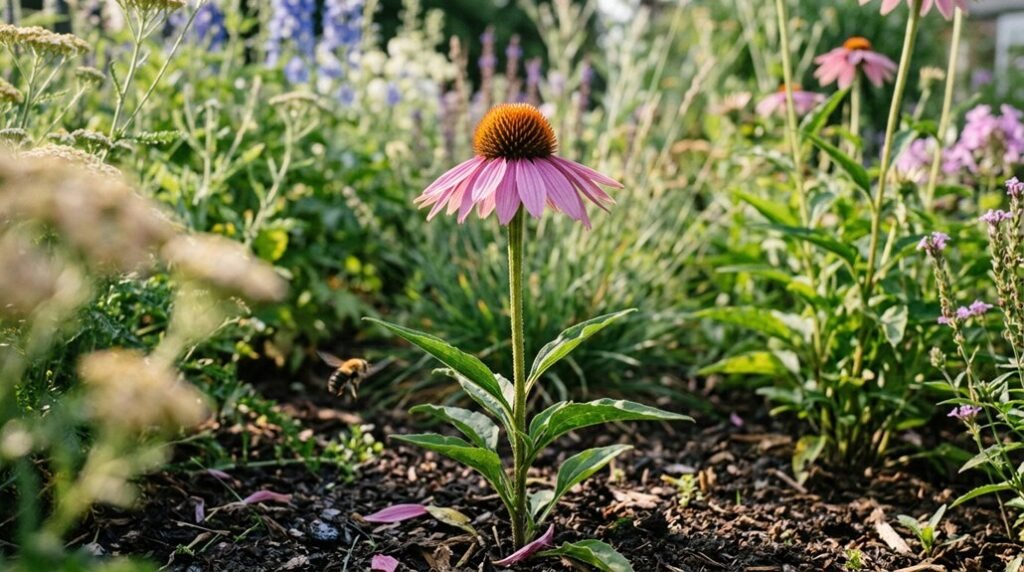


You want a thriving pollinator garden, and you need plants that deliver reliable results without demanding constant attention. Coneflower (Echinacea purpurea), black-eyed Susan (Rudbeckia fulgida), coreopsis, monarda, and agastache form the backbone of a sustainable design; these drought-tolerant perennials thrive in USDA zones 3 to 9, require full sun, and bloom from June through October with minimal intervention. Plant them in clusters of three to five specimens, spaced 18 to 24 inches apart in well-drained soil, and deadhead spent flowers to extend the blooming period. The tubular blossoms of agastache ‘Blue Fortune’ specifically target long-tongued bees and ruby-throated hummingbirds, while the composite flower heads of Echinacea and Rudbeckia support over 40 native bee species. You’ll build layered structure by positioning taller monarda (24 to 48 inches) at the rear, mid-height coneflower (18 to 36 inches) centrally, and compact coreopsis (12 to 18 inches) forward. But selecting the right plants is only the first decision; the arrangement you choose determines whether pollinators merely visit or establish residence in your landscape.
Beginner-Friendly Pollinator Plants for Full Sun
Where do you begin when you want to fill your sunny beds with plants that bring real pollinator activity without demanding expert skills? You’ll find your answer in pollinator-friendly perennial flowers that thrive in full sun, offering you extended bloom periods from summer through fall while drawing bees and butterflies to your garden with minimal intervention.
You can’t go wrong with coneflower (Echinacea purpurea), which you plant in USDA zones 3 to 9, reaching 24 to 36 inches tall and flowering from June through August. Pair it with black-eyed Susan (Rudbeckia fulgida), a reliable rudbeckia variety that you establish once and enjoy for years, blooming yellow-orange from July to September in zones 3 to 9.
Add coreopsis, particularly ‘Moonbeam’ or ‘Zagreb,’ for threadleaf texture and continuous golden blooms, then include monarda (bee balm) to complete your quartet. You’ll provide overlapping nectar sources across 18 to 48 inch heights, ensuring your pollinators feed from June into October.
Drought-Tolerant Pollinator Plants That Thrive on Neglect
You don’t need to babysit every plant in your garden to keep pollinators coming back, especially when you select varieties built for dry spells and sporadic attention.
Start with drought-tolerant pollinator plants like Helenium and Coreopsis, which thrive in sun-loving, dry spots while drawing bees and butterflies throughout the season. Add Achillea, a neglect-tolerant perennial that delivers drought-tolerant performance from mid-spring through fall. Agastache brings aromatic flowering blooms that attract bees and hummingbirds from summer onward. For robust, drought-resistant options, include Rudbeckia and Echinacea, both offering exceptional drought-tolerant performance in sunny conditions with minimal intervention. These drought-tolerant choices prove you can support pollinators without constant care.
Recommended Products

High-Value Wildflower: 10,000 Black eyed susan seeds perennial (tender) deliver masses of yellow daisy blooms for pollinator gardens. Great wildflower seeds for beds, borders, containers, and meadows, USDA 1-12.

Native Wildflower Bloom: Black Eyed Susan (Rudbeckia hirta) is a North American native perennial producing bold golden-yellow petals around a dark chocolate center; grows 24-36 in tall; blooms mid-summer through fall; ideal for meadows and bouquets.

Bright & Vibrant Blooms: The striking yellow black eyed susan (Rudbeckia Hirta) boast strong visual appeal. Whether adorning gardens, enhancing landscapes, or decorating courtyard corners, they effortlessly add a cheerful splash of color, infusing both indoor and outdoor spaces with abundant vitality and warmth
Late-Season Pollinator Plants for Fall Nectar
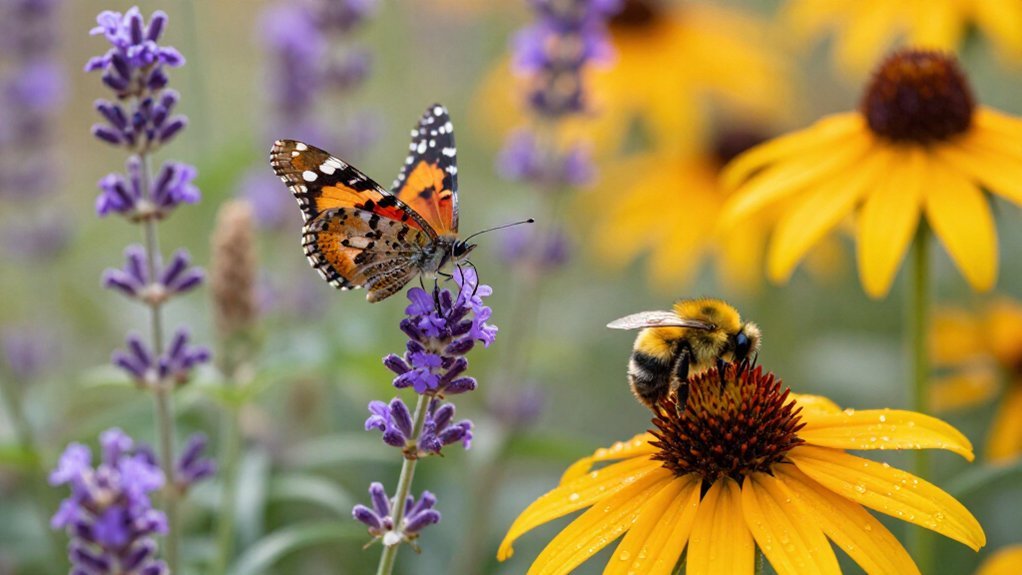
How can you keep pollinators fed when summer’s peak blooms begin to fade? You’ll extend your garden’s value by planting fall bloom perennials that deliver late-season nectar when forage becomes scarce.
Asters anchor your autumn display, blooming mid-summer through fall and drawing bees and butterflies with their profuse daisy-like flowers. You’ll find cultivars like ‘New England’ and ‘New York’ asters thrive in USDA zones 4-8, reaching 3-6 feet with full sun and well-drained soil.
Rudbeckia, commonly called Black-Eyed Susan, offers an extended bloom window from mid-summer through fall, attracting numerous pollinators with its golden rays. You’ll plant coneflower alongside it, since Echinacea species bloom from mid-summer to fall, providing both nectar and long-lasting cut flowers for your home.
Coreopsis completes your fall nectar sources, flowering summer through fall while supporting bees and butterflies. You’ll deadhead spent blooms monthly to encourage continuous flowering, then leave seed heads standing for winter birds.
Recommended Products

Pollinator Paradise: Attracts bees, butterflies, hummingbirds, and beneficial insects with nectar-rich blooms that support a thriving garden ecosystem.

EASY TO GROW – INSTRUCTIONS INCLUDED: Step-by-step instructions make growing wild bergamot simple. Whether you’re a beginner or seasoned gardener, you’ll nurture healthy bee balm plants that thrive indoors or outdoors with ease.

Dual-Purpose Beauty: Enjoy the best of both worlds! Bee Balm delivers stunning ornamental value with its shaggy, crown-like flowers while belonging to the mint family with aromatic leaves perfect for herbal uses. Grow it in flower beds, herb gardens, or containers for double the gardening pleasure
Tubular Flowers for Hummingbirds and Long-Tongued Bees
While late-season blooms sustain generalist pollinators through autumn, your garden can also serve specialists with more demanding physical requirements. You’ll attract hummingbirds and long-tongued bees by planting tubular flowers, whose deep nectar tubes accommodate unique feeding apparatus. Hummingbirds prefer bright red, orange, and pink blossoms that allow easy nectar access with minimal landing effort.
For a pollinator-friendly display, select Penstemon, Agastache, and Echinacea, three perennials thriving in USDA zones 3-9 with full sun exposure. You’ll maximize nectar access for long-tongued bees by choosing single blooms rather than doubles, which obstruct pollinator entry.
Practice mass planting in sun-lit, sheltered spots, grouping three to five specimens of each variety with 12-18 inch spacing. This approach enhances visitation by both hummingbirds and long-tongued bees throughout the growing season.
3 Complete Pollinator Garden Layouts by Yard Size
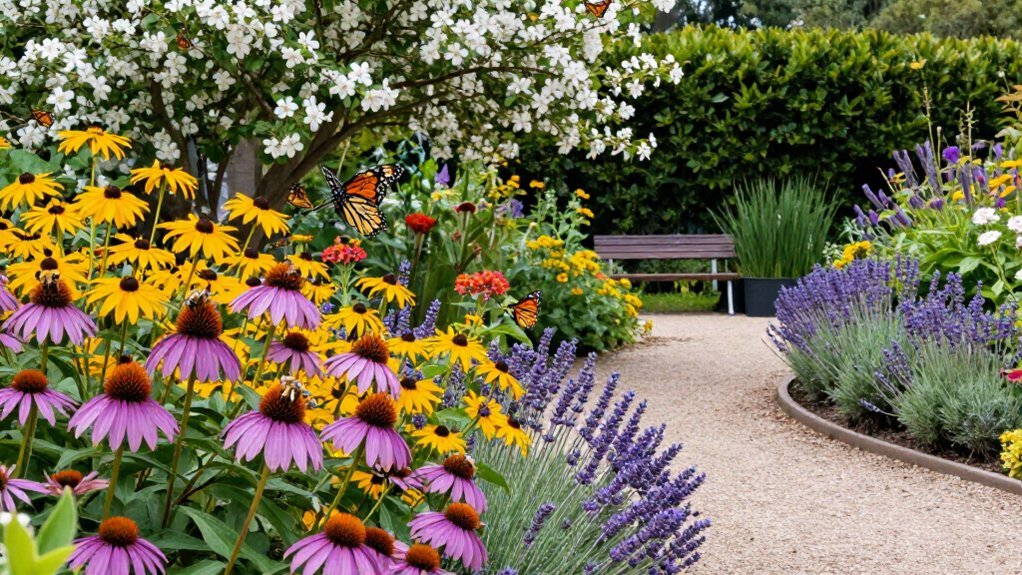
Whether you’re working with a modest balcony or an expansive backyard, you’ll find that scale doesn’t limit your ability to support pollinators, it simply shapes how you arrange your plantings. Your pollinator garden layouts should match your yard size, incorporating sun-loving perennials like Echinacea and Rudbeckia across every tier.
For small spaces, you’ll cluster compact varieties in 3’x3′ grids, grouping 3–5 plants per species to maximize foraging efficiency. Medium yards let you layer mid-to-late season bloomers with tall backdrop species, creating 4–6 square feet of dense bloom mass. Large gardens exploit plant height variety, stacking Rudbeckia, Monarda, and Agastache for vertical structure and continuous bloom from early summer through fall.
You’ll extend blooming season by mixing annuals with self-seeding perennials, ensuring nectar and pollen sources never lapse. Position water sources and shelter elements within 6–12 feet of foraging patches, integrating shallow bowls and protected understory to boost visitation rates across all layouts.
Recommended Products

Hardy in USDA Zones 5-9, Trademarked. Due to varying agricultural regulations, we do not ship to the following states: AK, AZ, CA, CO, ID, MT, NV, OR, UT, WA and HI.

PLEASE DO NOT ORDER IF YOU LIVE IN ONE OF THESE USDA RESTRICTED STATES: AK, AZ, CA, CO, ID, MT, NV, OR, UT, WA AND HI. Hardy in USDA zones 5-9.