
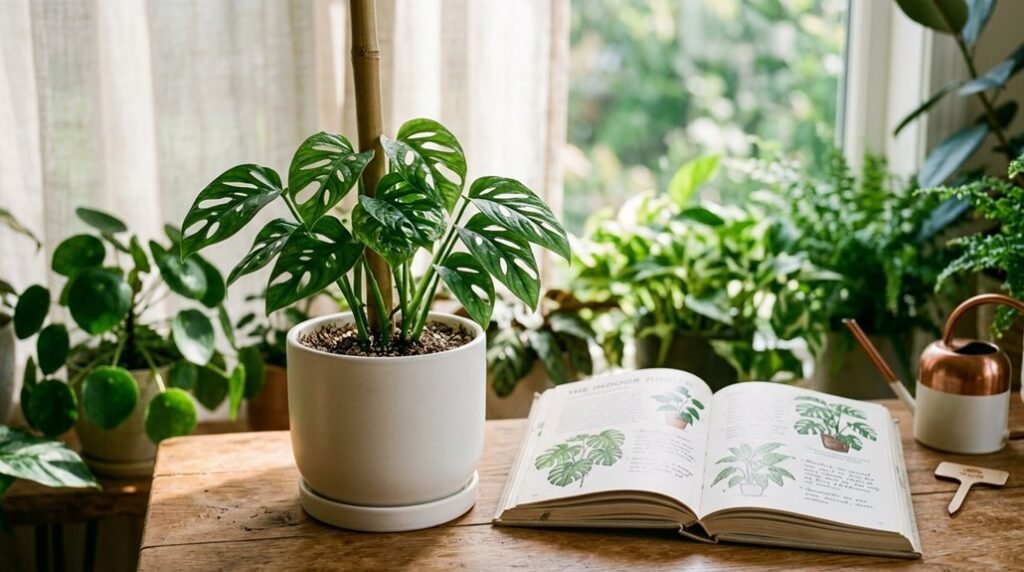


Your Monstera‘s leaves stay small because something in its environment blocks the genetic potential coded into every cell. You might have a young plant, perhaps a Monstera deliciosa barely two years old, or you might have placed it three meters from the nearest window, where light drops below 100 foot-candles. You could be watering on a rigid schedule instead of checking soil moisture to two knuckles deep, or you might have skipped the moss pole that triggers mature growth in climbing aroids. The fix isn’t guesswork: measure your light, inspect your roots, and check whether your pot drains within thirty seconds. Each factor you correct pushes the next leaf closer to the dinner-plate size you expect. But one mistake, repeated silently month after month, undoes progress faster than you notice.
Is Your Monstera Old Enough for Big Leaves?
Why exactly does your Monstera keep unfurling those disappointingly petite leaves when you have seen photographs of towering specimens with dinner-plate foliage?
Your plant may simply need more time. New leaves on Monstera deliciosa often emerge small and only gradually enlarge as the plant matures, with older foliage typically displaying greater size and deeper fenestration. Genetics and age heavily influence this progression, so younger plants or less mature growth regularly produces smaller, unfenestrated new leaves.
Even when you’ve purchased what sellers describe as a several-year-old specimen, you’re likely witnessing juvenile growth patterns that persist until conditions align for maturation. Seasonal timing also shapes development, with larger, fully fenestrated new leaves more likely during favorable growth periods.
Before adjusting light or nutrients, assess whether your Monstera has genuinely aged into its productive phase.
Recommended Products
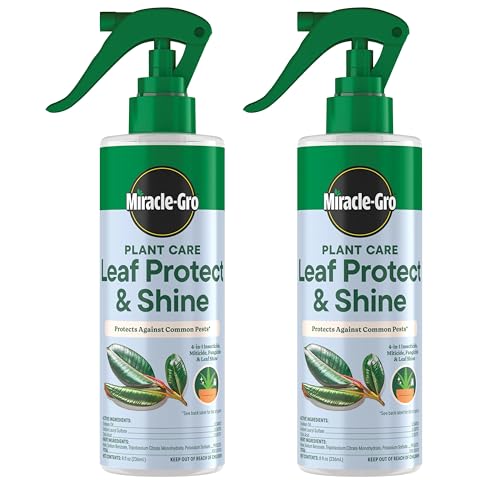
MULTI-PURPOSE PLANT SPRAY: Miracle-Gro Plant Care Leaf Protect & Shine plant spray helps plants in four ways by protecting against mites, insects, and disease control while also beautifying plants for houseplant care

Made for Monstera Plants – Formulated to support healthy growth in monstera and tropical houseplants.
Why Indoor Light Loss Shrinks New Monstera Leaves
When your Monstera receives less light than it’s accustomed to, whether from shifting seasons, a moved curtain, or a new building across the street, you’ll notice new leaves emerging smaller and less fenestrated because the plant conserves energy by reducing leaf surface area. The direction your window faces determines baseline intensity: east-facing windows provide gentle morning light that supports moderate growth, while south or west exposures deliver the brighter conditions that encourage larger, more divided leaves in mature specimens. If you’ve recently moved your plant away from its established light source, or if supplementary fluorescent fixtures have burned out without replacement, you’ve likely triggered this downsizing response, which persists until light levels stabilize and the plant re-acclimates to support expanded growth again.
Recommended Products

72 LED Grow Light Full Spectrum: This grow light for indoor plants contains 72 LEDs, including 34 Cold White LEDs, 24 Warm LEDs, 10 Red LEDs and 4 Blue LEDs, which can accelerate plants growth stage, such as promoting plants germination, blooming, flowering and fruiting. By emitting full-spectrum light, this plant light provides plants with the light they require for all growth stages

Full Spectrum LED Grow Light: This grow light features 72 LEDs that span the entire spectrum from 380nm to 800nm. It consists of 34 white LEDs (5000K), 24 warm white LEDs (2800K-3000K), 10 red LEDs (660-665nm), and 4 blue LEDs (4800K-5000K), delivering a well-rounded and optimal light spectrum for plant growth. Suitable for all stages of plant development and a variety of plants including succulents, orchids, herbs, monstera, tomatoes, and more. This light enhances the overall health and vitality of your plants

4000K DAYLIGHT: Imitate the solar spectrum, customize a more ideal full life cycle full spectrum supplementary light program, covering the entire visible spectrum of 400nm-780nm; Color rendering index Ra is close to 100, infinitely close to natural light, suitable for every cycle of plant growth, effectively promotes plant growth, and improves crop yield and quality
Light Intensity Matters
How quickly you’ve noticed those new leaves unfurling smaller than you’d hoped, and you’re right to suspect your window might be the culprit. Your Monstera’s leaf size and fenestration depend heavily on light intensity, so when indoor conditions deliver less than what those broad, split leaves require, you’re seeing the consequences in real time.
A drop in light intensity after a period of stronger exposure triggers smaller, often solid leaves without those signature holes. Even when your blinds filter several hours of direct sun, factors like distance from the glass, spectral quality, and diffusion determine whether your plant actually receives enough photons for robust photosynthesis. You’re managing a delicate balance.
When you relocate your Monstera or adjust its setup, light acclimation becomes essential. Sudden shifts in light intensity temporarily stall growth and fenestration, so you’ll want to make gradual transitions. Inconsistent patterns, even in otherwise bright rooms, prevent mature leaf development. You’re aiming for steady, adequate intensity, not just occasional brightness.
Window Direction Counts
Your window’s compass orientation directly determines how much usable light reaches your Monstera, and this matters more than most indoor gardeners realize. When you move your plant from a south-facing exposure to a north-facing one, you’re fundamentally altering its energy budget, and new leaves will respond by shrinking until the plant stabilizes.
- East-facing windows deliver gentle morning sun that builds consistent growth without scorching delicate tissue.
- West-facing exposures blast intense afternoon heat, which can stress leaves unless you filter it through sheer curtains.
- North-facing openings provide the lowest light direction intensity, often triggering smaller, immature foliage with minimal fenestration.
You can compensate by positioning your Monstera within 3-4 feet of the glass, rotating weekly for even exposure, and accepting that seasonal light reduction will temporarily suppress leaf size until conditions stabilize.
The Pot Size Mistake That Stunts Monstera Growth
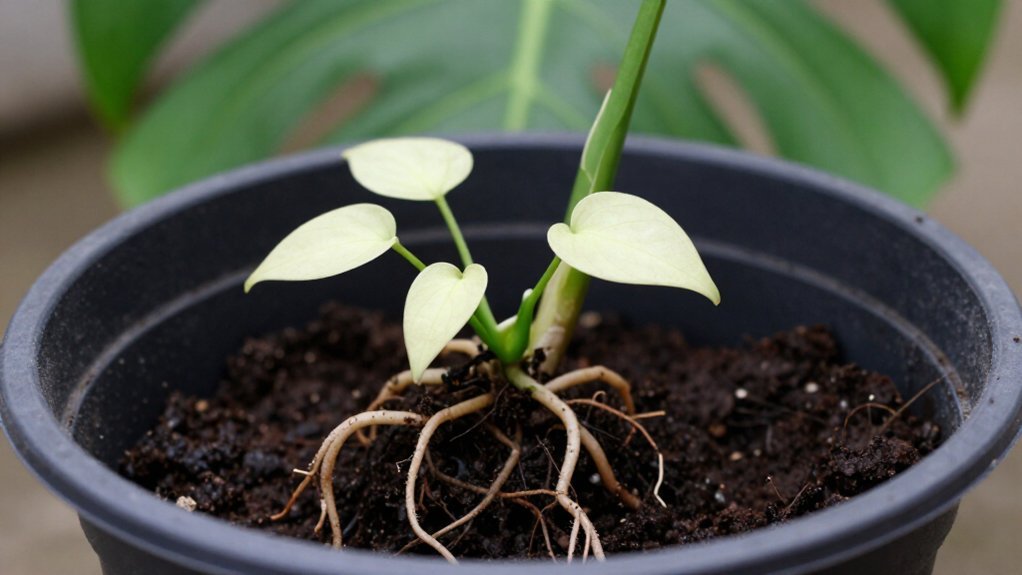
Why might your Monstera’s leaves stay stubbornly small despite your best efforts? Your pot size choice directly controls root expansion, and restricted roots signal your plant to produce smaller foliage through reduced nutrient and water uptake.
You might notice soil drying within three days or spot roots circling the container, clear signs you’ve waited too long. When you re-pot, select a container only two inches larger in diameter, since oversized pots disrupt root signaling and delay mature leaf development. Very large containers also complicate bottom watering, leaving your dense root ball inconsistently moist.
Refresh with well-draining aroid mix, ensuring your Monstera accesses steady moisture and nutrients. This measured upgrade, completed in spring across USDA zones 10-12, gradually supports larger leaves and eventual fenestration without overwhelming your plant’s established system.
Recommended Products

Complete Installation Kit: This set features 4 stackable 16" Moss poles reaching 48" height,16ft jute rope and 6.6ft velcro tape. With easy instructions, gently secure stems to help guide plant climber upward growth

Sturdy and Easy to Use: Crafted from premium, durable materials, our 2-pack of 48-inch moss poles empowers your climbing plants with reliable support while ensuring hassle-free installation

STRONG & BENDABLE 29” MOSS POLE – Crafted with a bendable metal core, these moss pole monstera plant supports trellis offer strong structure and shapeability. Perfect for climbing plants like Monstera, Pothos, and Philodendron.
Why Climbing Support Unlocks Bigger Monstera Leaves
When you provide a moss pole or sturdy climbing support, you’re triggering your Monstera’s vertical growth response, which activates secondary root development along the stem and redirects energy toward producing larger, more mature foliage. Your plant’s aerial roots naturally seek attachment points, and securing these to a support, without forcing them, encourages the upward habit that precedes fenestration and substantial leaf expansion. This climbing structure, paired with adequate bright, indirect light, aligns your Monstera’s growth with its natural vining behavior, potentially accelerating the emergence of those impressive, splitting leaves you are hoping to achieve.
Recommended Products

🌿 【Self-Watering Pots with Water Level Indicator】 Designed for busy plant lovers, our 8/10/12 self-watering pots feature a built-in ABSORBENT COTTON WICK SYSTEM that automatically draws water from the detachable bottom tray. The TRANSPARENT WATER LEVEL WINDOW WITH MEASUREMENT MARKINGS lets you monitor hydration at a glance, ensuring no overwatering or underwatering. Perfect for indoor/outdoor plants, this system keeps soil evenly moist for up to 7-10 days—ideal for vacations or hectic schedules.

Clear Plant Pots with Drainage for Better Plant Care – The transparent design allows you to observe root growth, soil conditions, and overall plant health, while drainage holes help improve airflow, prevent excess water buildup, and support healthier roots

【Cotton Wick Self-Watering Set】Montresor 8/10/12 Inch self-watering pots are a 3 pack with a built-in self-watering system that uses absorbent cotton wicks to draw water from the detachable bottom tray into each planter. This keeps soil evenly moist for indoor outdoor plants and supports plants during vacations or hectic schedules with less frequent watering.
Vertical Growth Trigger
How exactly does a simple stake transform your Monstera’s leaf size from modest to magnificent? When you install a Moss Pole, you’re not merely propping up stems, you’re activating a vertical growth trigger that redirects your plant’s energy upward, mimicking the tree-climbing habit that produces mature, fenestrated foliage in USDA zones 10 through 12.
- Vertical ascent signals your Monstera to allocate resources toward taller stems, concentrating development at the apex rather than dissipating it through horizontal wandering.
- Upright positioning improves photosynthetic efficiency along the main stem, fueling larger leaf production as new growth emerges higher on the vine.
- Supported growth aligns with natural climbing patterns, contrasting sharply with the smaller leaves typical of unsupported, free-standing specimens left to sprawl.
Aerial Root Support
The vertical growth trigger you have just established sets the stage for something even more remarkable, your Monstera’s aerial roots actively engaging with their new support system to unleash substantially larger foliage. When you provide a moss pole or sturdy stake, you’re inviting these specialized roots to anchor and absorb moisture and nutrients directly from their climbing surface.
Your aerial roots will naturally explore the support, so simply tie the stem loosely and let them attach at their own pace. This vertical orientation mimics the plant’s native tropical habitat, where it climbs toward canopy light in USDA zones 10 through 12.
Combine this structure with bright, indirect light and balanced fertilization, and you’ll redirect energy from horizontal spread into substantial, fenestrated leaves. You’re essentially reprogramming growth patterns toward maturity, with larger foliage emerging as the reward for your structural intervention.
How Old Soil Starves New Monstera Leaves
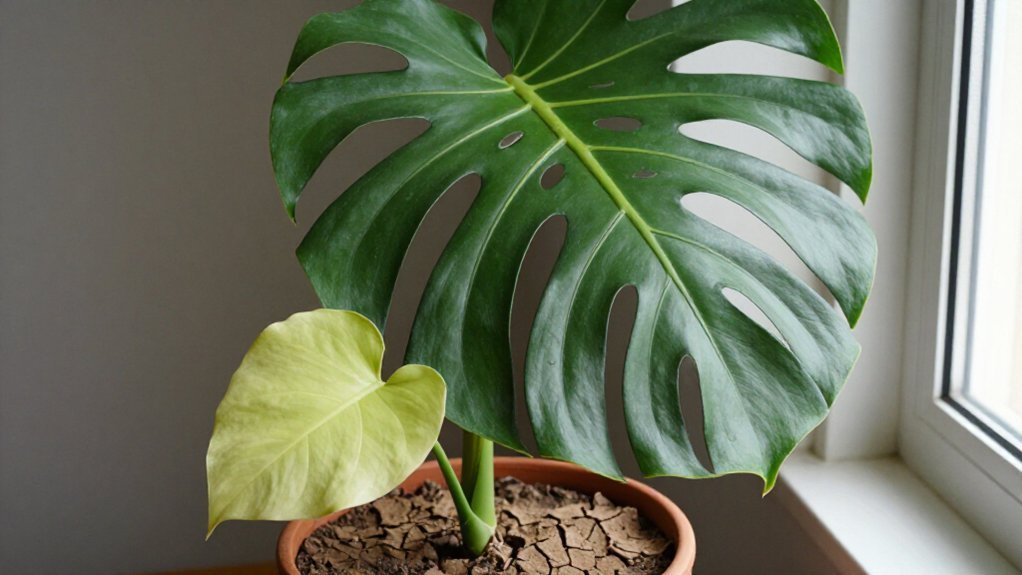
Perhaps you’ve noticed your Monstera’s newest leaves emerging smaller than you’d hoped, even as you’re providing adequate light and water, and you’re beginning to suspect that the potting mix itself might be the hidden culprit behind this stunted growth.
Soil depletion occurs gradually, and you’re likely overlooking how exhausted your potting mix has become. Over two to three years, organic matter breaks down, nutrients leach away, and the structure collapses into dense, poorly aerated particles that suffocate roots and starve new growth.
Soil exhaustion is silent: over time, organic matter decays, nutrients vanish, and roots suffocate in compacted, lifeless mix.
- Your old soil has lost essential nitrogen, phosphorus, and potassium, forcing your Monstera to ration resources toward survival rather than expansive leaf development.
- Compacted substrate restricts root expansion, limiting the vascular flow needed to support larger, fenestrated foliage.
- Degraded drainage creates inconsistent moisture zones that stress roots and reduce nutrient uptake efficiency.
You’re wise to repot every 18-24 months using a fresh, well-draining aroid mix; this reintroduces nutrients, restores aeration, and reenergizes your plant’s capacity for producing those impressive, mature leaves you cultivated it for.
Recommended Products
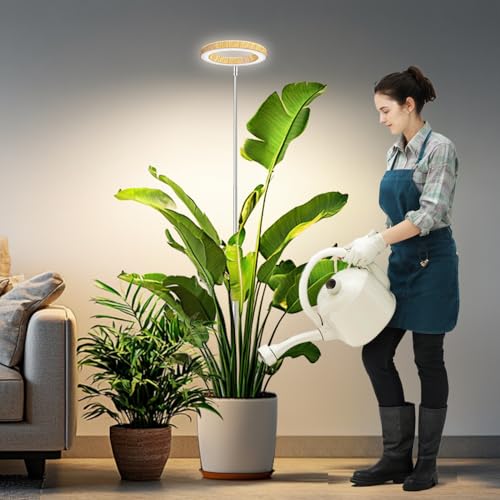
Elegant Faux Woodgrain Design: This halo grow light has a unique faux woodgrain design that complements any interior space. Compared with other plant lamps using bamboo materials, ours will not crack or fall off. Whether it’s used as a light for indoor plants or adding a stylish content to your home decor, this plant lamp is both practical and beautiful

𝐓𝐚𝐥𝐥𝐞𝐫 𝐚𝐧𝐝 𝐌𝐨𝐫𝐞 𝐒𝐭𝐚𝐛𝐥𝐞: This 65-inch large plant lights for indoor growing provides a taller and more stable design, ensuring that the LED grow light stands securely, allowing you to position it at the perfect height for your plants.

FULL SPECTRUM & NATURAL LIGHT: A19 full spectrum grow light appears 4000K white to eyes but has a red/blue light spectrum. Same as natural sun shine, perfect for tomatoes, cucumbers, peppers, leafy greens and herbs at all growth stages.
Why Your Watering Routine Limits Leaf Size
You’ve addressed your soil situation, yet your Monstera’s leaves remain stubbornly small, and now you’re wondering whether the way you’re actually applying water might be the overlooked variable stalling your plant’s progress toward those broad, fenestrated specimens you see thriving in other collections.
Your watering method directly shapes root health and, consequently, leaf size. If you’re relying solely on bottom watering in pots larger than six inches, you’re likely leaving upper roots chronically dry, which restricts nutrient uptake and keeps foliage compact. Frequent watering every five to seven days without occasional top watering compounds this problem in larger containers, creating uneven moisture zones that stress roots.
Switch to top watering periodically to ensure complete soil saturation. Watch how water travels through your mix, and adjust timing based on actual dryness rather than rigid schedules.
Recommended Products

EFFORTLESS LEAF CARE: Say goodbye to dusty plant leaves! Our Leaf Lovers (2.0) microfiber gloves make leaf cleaning a breeze, ensuring your Fiddle Leaf Fig, Monstera, and all your houseplants gleam without the hassle. Perfect for gentle and precise cleaning of your delicate leaves.

Effortless Leaf Cleaning – No More Dusty Plants!: Transform your plant care routine with these microfiber gloves for plant dusting, designed to gently remove dust, dirt, and debris from delicate leaves. Perfect for Fiddle Leaf Figs, Monsteras, and all your favorite houseplants, these gloves make every leaf sparkle while improving light absorption and photosynthesis.

🌿 MONSTERA MAGIC: Specifically formulated for Monstera plants, our 3-1-2 Liquid Fertilizer Mist unlocks their full potential, promoting healthy, vibrant growth and those iconic split leaves.
When Fertilizer Helps Monstera Leaves: and When It Doesn’t
Why exactly have you been fertilizing your Monstera so faithfully, only to watch it push out leaf after leaf that stays stubbornly small? You’ve stuck those Miracle-Gro sticks into the soil, four to six of them, expecting fenestrated glory, yet the leaves emerge miniature and underwhelming. Fertilization has triggered new growth, but it hasn’t delivered the size or splits you crave.
Here’s when feeding works, and when it backfires:
- It stimulates new leaf production, but cannot compensate for inadequate light intensity
- It supports expansion only when roots have room to absorb and process nutrients efficiently
- Overdoing it, or pushing growth in suboptimal conditions, yields soft, undersized foliage
Your fertilization regimen isn’t broken; it’s simply incomplete. Without sufficient PAR levels and appropriate root space, nutrients alone cannot force maturity.
Recommended Products

SIGNATURE SUNRISE & SUNSET SIMULATION – Give indoor plants a more natural daily light rhythm instead of constant, unchanging illumination. The 12-hour cycle starts with soft morning light, gradually reaches peak brightness around midday, then gently dims toward sunset—bringing an outdoor-like sunlight experience indoors.

Built for Large & Tall Indoor Plants – Stable, Bright, and Adjustable: Designed specifically for floor plants and tall indoor trees, this grow light delivers strong, even lighting with 80 high-output LEDs for wider coverage. The heavy-duty metal base with non-slip pads keeps the light firmly in place—no tipping or wobbling, even for large pots. Adjustable height from 20 to 68'' easily fits corners, planters, and tall plants.

☀ High Performance & Energy Saving: LED Grow Light Bulb A19 Bulbs deliver 150-degree light output.Used High Lumen Led Chips replace to 100w traditional light bulb, and power consumption, energy saving over 85%.
The Real Timeline for Big, Split Monstera Leaves
How long should you realistically wait for your Monstera to produce those dramatic, dinner-plate leaves with elegant Swiss-cheese splits? You’ll need patience, because this growth progression unfolds gradually, not overnight.
Your Monstera’s new leaves often arrive small and expand over subsequent growth cycles, with older, higher leaves typically reaching larger dimensions as the plant matures. Fenestration depends on age, adequate light exposure, and genetics, so vertical growth supported by a moss pole channeling energy upward accelerates mature leaf development.
Expect 1–2 years for noticeable size increases, and 3–4 years for consistently large, split foliage, even under optimal conditions. Spring growth spurts, triggered by increased light and warmth, offer the most visible progress, but short-term adjustments won’t force immediate fenestration.
Recommended Products

Sturdy and Durable Support Sticks: Our four-pack moss poles are made from durable materials, consisting of two 28-inch and two 48-inch poles, specifically designed for climbing plants like ivy, cat tail, and Swiss cheese plants. Whether you’re a beginner or an experienced gardener, their bendable design and easy assembly make these poles an indispensable part of your plant care toolkit, helping you create a lush indoor environment.

STRONG & FLEXIBLE 48” MOSS POLE – Crafted with a bendable metal core, these moss pole trellis monstera plant supports offer strong structure and shapeability — perfect for climbing plants like Monstera, Pothos, and Philodendron.

𝗣𝐚𝐜𝐤𝐚𝐠𝐞 𝗜𝐧𝐜𝐥𝐮𝐝𝐞: 2 (1 inch x 30 inch) Bendable Moss Pole Monstera Plant Support, Easy to tie 6.6 ft Jute Rope, 5 Green Plant Ties (3.9 inch), 0.5m Velcro Tape, 2 Leaf Clips (1.3 inch), and 2 Plastic Label (3.9 x 1.96) inch.