


You need to know exactly how far your grow light should sit from your plants, because distance determines whether your tomatoes, cannabis, or orchids thrive or fail. Seedlings demand 24–36 inches at 100–300 μmol/m²/s, vegetative growth needs 18–24 inches at 400–600 μmol/m²/s, and flowering stages require 12–18 inches at 600–900 μmol/m²/s. You will adjust in 2-inch increments, watching for leaf burn or stem stretch, and you will validate your setup with a PAR meter or the back-of-hand test. Your documentation of each adjustment builds the precise protocol your specific cultivar, whether ‘Cherokee Purple’ tomatoes in USDA Zone 7 or ‘OG Kush’ in controlled environments, requires for maximum yield. The consequences of getting this wrong are severe, and the warning signs appear faster than you might expect.
The Exact Grow Light Distance for Every Growth Stage
Why does the same fixture hover at two feet one week and eighteen inches the next? You’re adjusting for growth stages, and each demands distinct PPFD targets.
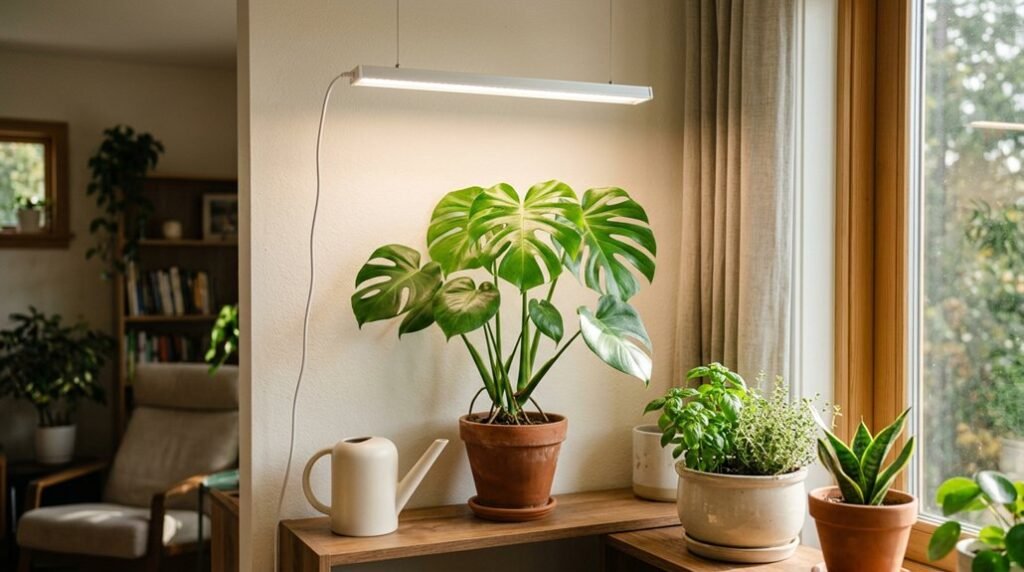
During seedling establishment, you’ll position your LED grow light at 24–36 inches, maintaining PPFD around 100–300 μmol/m²/s across 16–18 hour schedules. As plants enter vegetative development, lower the distance to 12–24 inches, targeting 400–600 μmol/m²/s with extended photoperiods.
For flowering, you’ll narrow the gap further, typically 12–18 inches, pushing PPFD to 600–900 μmol/m²/s on twelve-hour cycles. With high-wattage fixtures, start vegetative phases at 18–24 inches, then descend gradually.
Don’t rely solely on measurements, though. You’ll validate light intensity using a PAR meter, confirming you’re hitting stage-specific PPFD targets rather than guessing. The hand-test offers quick verification, but precision demands proper instrumentation.
Recommended Products
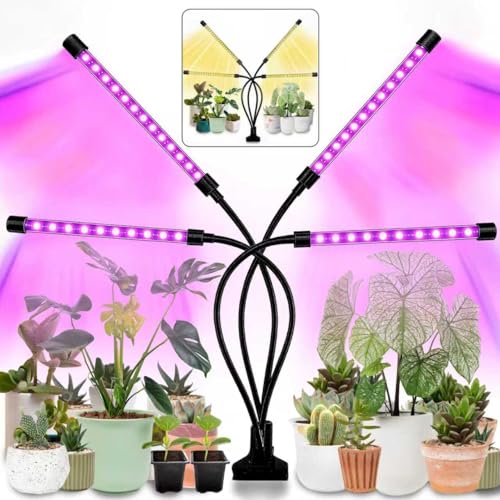
🌻Efficient LED Combination: This LED lamp has grow lights made up of 80 efficient growing LEDs ( 32 red lights, 12 blue lights,20 yellow lights and 16 white lights). It meets the conditions of plant growth without sunlight. 1--Full Spectrum(380nm-800nm): Suitable for all plants to root and sprout. 2--Red(660nm)+BLUE(460nm) Spectrum: for blooming and fruits. 3--Red+Blue+Full Spectrum: A mix of Red+Blue+Warm White is best to fuel the growth of your plants.

Built-In Auto Timer & 4-Level Dimmer, No External Timer Needed. DOMMIA smart controller: 6/12/16H auto cycle timer, 4 brightness levels (25%-100%), power-loss memory resumes your last setting. Unlike typical T5 tube lights needing separate timers with one brightness, everything is built into one USB-powered controller. Set it and forget it

High-Efficiency Full Spectrum Lighting:Foldable strips features 148 premium chips (120 White + 20 Red + 8 Blue). The blue light enhances photosynthesis for lush foliage, while the red light promotes blooming, fruiting, and seed germination. The white light provides a balanced, sun-mimicking full spectrum that is ideal for all growth stages of various plants.
What Happens When Grow Light Distance Is Wrong?
How exactly does a few inches of misplacement unravel weeks of careful cultivation? When you position your grow light height incorrectly, you trigger plant stress that manifests in distinct, damaging ways.
Move your light too close, and you’ll witness light burn: bleached leaf tips, yellow-brown spots, and upward curling as intense photosynthetically active radiation overwhelms your canopy. Your hand test confirms this; if your skin feels scorched, you’ve failed the distance test.
Position lights too far, and shading/insufficient light causes leggy growth, pale leaves, and airy flowers. Your PPFD plummets below optimal light thresholds, with studies showing flowering yields drop roughly 40% when readings fall under 600 μmol/m²/s.
- Light distance directly controls your PPFD delivery and photosynthetic efficiency
- Target seedling 100–300, vegetative 400–600, flowering 600–900 μmol/m²/s for each stage
- Small adjustments prevent irreversible damage and maximize your harvest potential
Recommended Products
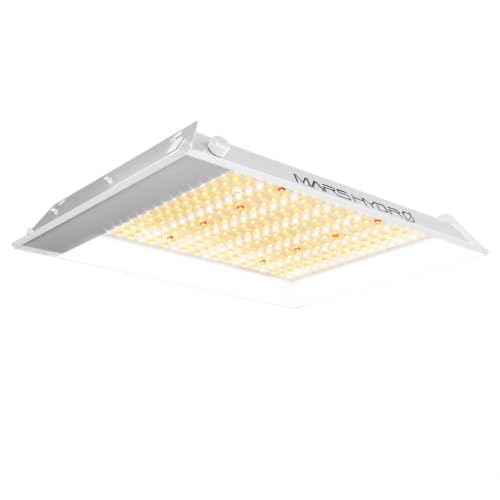
2026 Upgraded TS600 with Dimmable Function: Experience the newly added dimming control, allowing you to flexibly adjust light intensity from seedling to flowering stages – optimizing growth while saving energy. Combined with our optimized diode layout, it delivers ultra-even PPFD distribution across your 2x2 grow tent, maximizing yield at every phase.

Higher Growing Power & Energy Saving: SANSI plant lights for indoor growing offer high growing power of PPFD: 804 μmol/s/㎡@1ft. Through the lens for secondary scientific light distribution, improves light utilization, giving plants more supplementary light. Using only 40W of power, equivalent to 600W incandescent bulbs. Based on 18 hours per day usage, save up to ninety PCT electricity, annual estimated cost 26.28

Premium LED Grow Light: Features advanced LED technology delivering high PAR output and exceptional energy efficiency for deeper light penetration.
6 Warning Signs Your Grow Light Distance Needs Adjustment
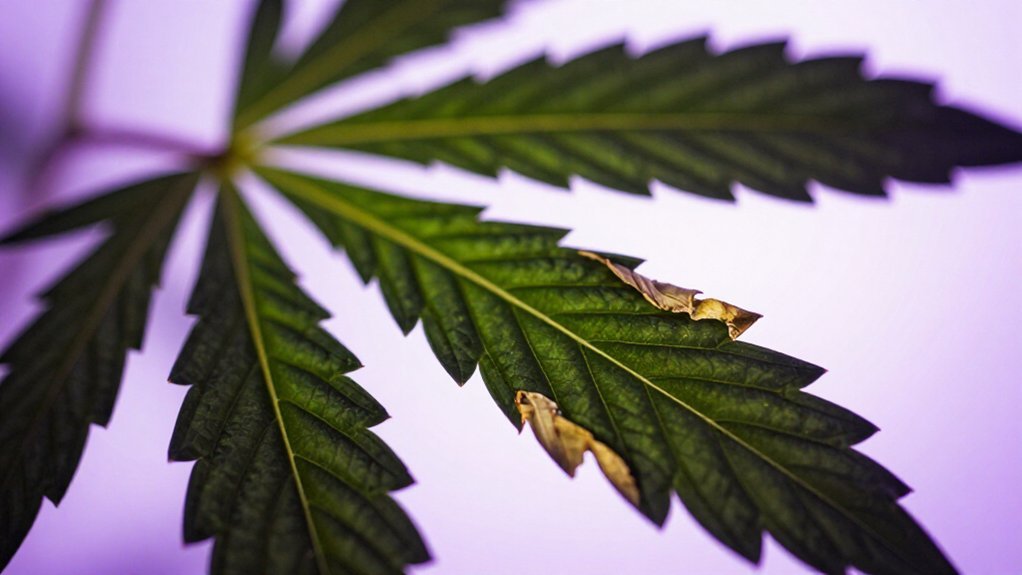
Where exactly should you position your grow light to catch problems before they cost you your harvest? You need to recognize six critical signs of light stress that demand immediate distance adjustment.
First, watch for light burn: bleached, yellow, or brown spots on upper leaf damage, plus upward curling and stalled development. Second, leggy growth signals insufficient light, your plants stretching pale and weak toward distant sources. Third, scorching tips reveal dangerous proximity causing permanent tissue damage. Fourth, fading colors indicate your light distance misses the mark. Fifth, plant leaning shows your canopy craves more intensity. Sixth, airy flowers confirm you’ve positioned fixtures too far.
Use these troubleshooting hints to distinguish light burn from nutrient burn by checking upper leaves for pale whiteness. Adjust your grow light distance the moment you spot any growth signal, and you’ll protect your harvest before irreversible harm sets in.
Recommended Products

Accurate PAR Test or Any Spectrum. Measure PAR (400–700nm) and PPFD accurately under various light sources. VBR-100 reads PAR directly without requiring spectrum profile selection, reducing setup errors and improving measurement reliability.

Measure PAR and UVA Light Accurately. Measure PAR (400–750nm) and UVA (320–400nm) irradiance intensity to understand how your grow lights actually perform. The PAR sensor IC is manufactured by a well-known Japanese semiconductor company, delivering reliable and consistent readings for grow lighting analysis.

Measure PAR, UVA and RGB PAR Breakdown. Measure PAR, UVA and RGB PAR Breakdown. X100 measures total PAR / PPFD for grow lights and also displays UVA, Red, Green and Blue PAR components. Instead of seeing only one total PAR number, you can better understand the light balance your plants receive.
Check Grow Light Distance Without a PAR Meter
When you’re tending tomatoes in Zone 8 or nurturing ‘Northern Lights’ cannabis without dropping hundreds on a PAR meter, you’ll need reliable methods to gauge your grow light placement that don’t sacrifice precision for affordability.
Start with manufacturer guidelines for your LED grow lights, typically 18–24 inches for mature plants and 24–36 inches for a seedling. Perform the hand-test at canopy level; if your skin feels uncomfortable heat, you’re risking heat stress and need immediate distance adjustments. Watch closely for plant stress signs like stretching, bleaching, or leaf burn, then fine-tune in 2–4 inch increments every few days.
- Document all observations in a grow journal to track patterns over time
- Adjust gradually rather than making large, sudden changes
- Monitor true leaf development as your cue to lower lights for established plants
Recommended Products

Reads test colors utilizing advanced LED digital technology

More for the money with this high quality Product
LED, HID, and Fluorescent Grow Light Distance Guide
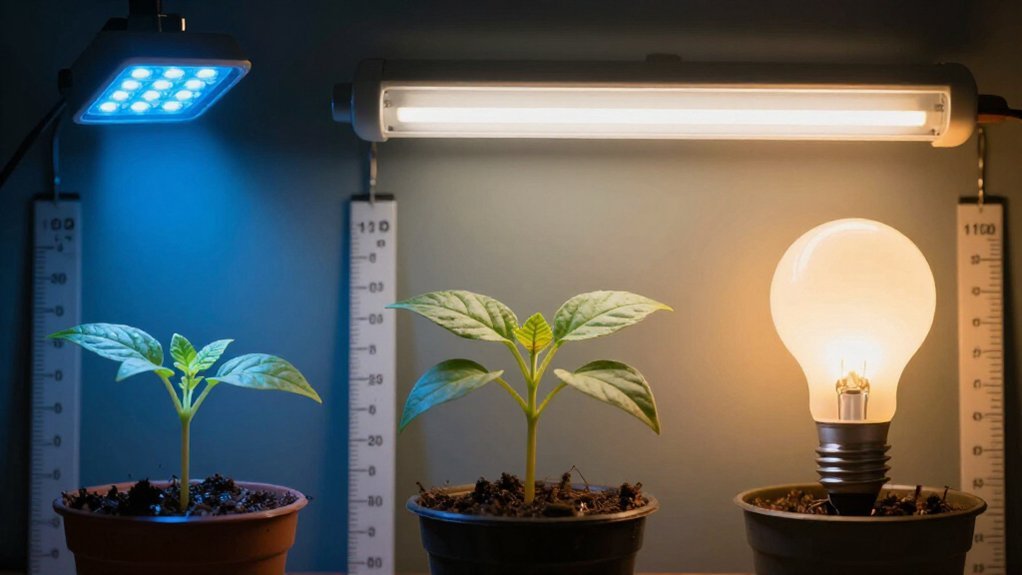
Why settle for guesswork when your tomatoes in Zone 7 or your ‘Blue Dream’ cannabis deserve precision tailored to their light source? You’ll position your LED grow light 24–36 inches above seedlings, lowering to 18–24 inches for vegetative growth and 12–18 inches once flowering begins. For HID fixtures, maintain 18–36 inches depending on wattage, balancing intensity against heat output. Fluorescent tubes sit closer: 6–12 inches for seedlings, extending to 12–16 inches as plants mature.
You shouldn’t rely on distance alone. Instead, you’ll track PPFD targets: 100–300 for seedlings, 400–600 for vegetative, and 600–900 for flowering. Adjust in 2-inch increments, watching for light burn or stretch. Your spectrum and lumen/PPFD targets matter more than any fixed measurement.
Recommended Products

OPTIMIZED FOR SEEDLINGS & VEG PLANTS: The indoor plant light features a scientifically designed diode layout and a high-performance LED driver, delivering 11000 lumens for optimal seedling and vegetative growth, ensuring your plants thrive at every stage

214 Full-Spectrum LEDs: Featuring one light head with 214 high-performance LEDs, this grow light delivers a broad 380–780 nm full spectrum that closely mimics natural sunlight. It provides bright, uniform illumination to support efficient photosynthesis and healthy plant growth. Especially suitable for seed starting and seedling development, it is an ideal supplemental light source for indoor plants.

4000K DAYLIGHT: Imitate the solar spectrum, customize a more ideal full life cycle full spectrum supplementary light program, covering the entire visible spectrum of 400nm-780nm; Color rendering index Ra is close to 100, infinitely close to natural light, suitable for every cycle of plant growth, effectively promotes plant growth, and improves crop yield and quality